LED street and parking lot lights
Cobra-heads, pole lights, wall packs and floods, with color, shielding, controls and savings
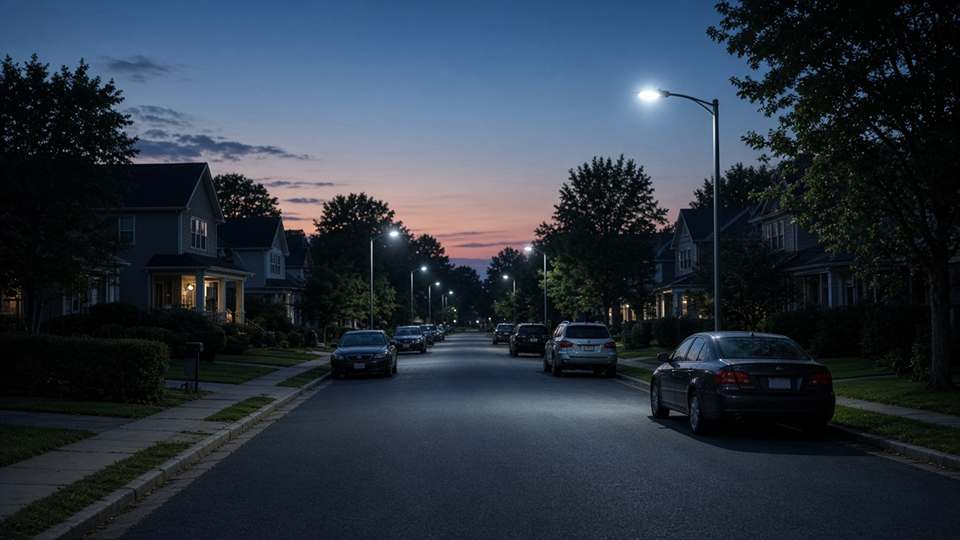
A cobra-head is the standard roadway luminaire: a slim, curved housing on a mast arm, named for its hooded shape. It was built for high-pressure sodium (HPS) lamps and is now almost always LED. It lights the road from the side, and a cutoff optic keeps most light out of the sky and windows.
Street and parking lights run about 4,000 hours a year, so they were among the first lighting jobs to go LED. They also draw the most complaints about glare, bright white light at bedroom windows and skyglow. This guide covers the fixture types, how to read their beam patterns, color and dark-sky choices, the photocell that switches them, solar street lights, and how much energy LEDs really save over HPS. For residential yards, see the outdoor lighting guide.
What are the main types of LED street and parking lights?
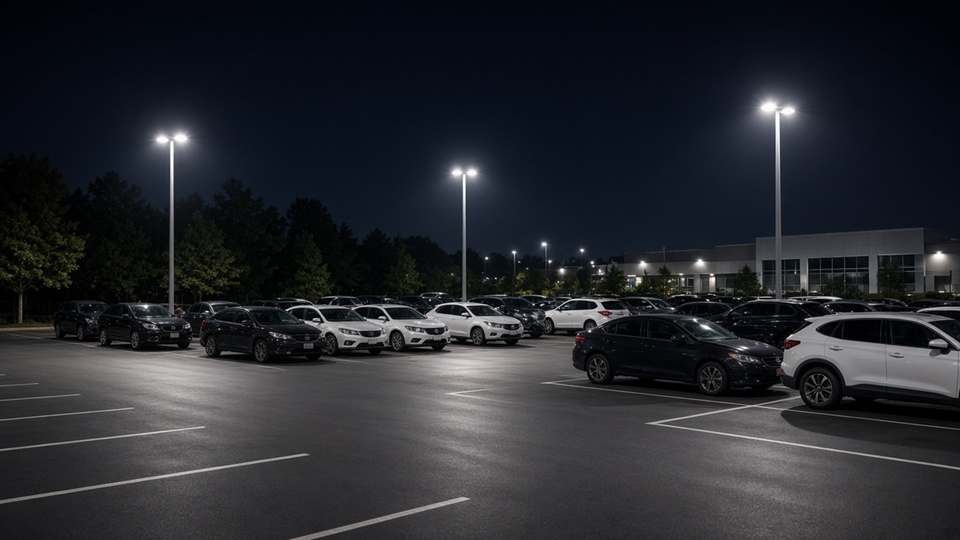
Four fixture families cover most outdoor public lighting. Cobra-heads on mast arms light roads, shoebox area lights on poles light parking lots, wall packs light building edges and doors, and floodlights light wide targets such as signs, yards and sports areas. Each is built around a different beam pattern.
A cobra-head usually sits 25–40 ft up on an arm that reaches over the road. LED versions run roughly 40–200 W and replace 100–400 W HPS heads, often with a standard photocell socket on top. A shoebox or area light is a flat rectangular luminaire on a 20–40 ft pole, mounted square for open lots or with a bracket for a pole at the lot edge. A wall pack is a compact box mounted 8–20 ft up on a building, throwing light outward and downward over doors, loading docks and walkways. A floodlight is a yoke-mounted fixture with an adjustable beam, which makes it the most flexible and the easiest to misaim.
| Type | Typical mounting | Typical LED power | Best for |
|---|---|---|---|
| Cobra-head | 25–40 ft pole arm | 40–200 W | Residential and arterial streets |
| Shoebox / area light | 20–40 ft pole | 75–300 W | Parking lots, plazas, car lots |
| Wall pack | 8–20 ft on a wall | 15–120 W | Doors, docks, building perimeter |
| Floodlight | Yoke, bracket or pole | 10–400 W | Signs, facades, yards, sports |
How do beam types and BUG ratings work?
The IES classifies outdoor beam shapes by number. Type II is a long narrow strip for roads, Type III a wider forward throw for pole edges, Type IV a half circle for walls, and Type V a round pattern for pole centers. The BUG rating scores backlight, uplight and glare, so lower is better.
The beam type decides where the light lands, so it matters as much as the lumen count. Choose it from the pole position: a Type V on a pole in the middle of a lot spreads light all around, while the same lumens from a Type III at the lot edge push light inward and keep it off the neighbor's lawn. Spacing is set by mounting height and distribution, and the manufacturer's photometric (.ies) file lets a designer check the layout in software before anything is bought. BUG ratings from IES TM-15 score a fixture on Backlight, Uplight and Glare from 0 to 5, and the Model Lighting Ordinance written by DarkSky and the IES sets the maximum rating for each lighting zone. A fixture with U0 sends no light above the horizontal.
What color and shielding do dark-sky and AMA guidance call for?
The American Medical Association has advised since 2016 that community LEDs be 3000 K or lower, with the lowest practical glare and dimming late at night. Dark-sky guidance adds full cutoff shielding, no uplight and lights that are on only when needed. Near turtle beaches and observatories, use amber, around 590 nm.
The first generation of LED streetlights was often 4000–5000 K and looked harsh because blue-rich light scatters more in the eye and in the atmosphere. At 3000 K a fixture gives up a little efficacy but removes much of that glare and skyglow. The DarkSky Approved program requires 3000 K or warmer and dimming controls, and many local ordinances now cap color temperature at 3000 K. Shielding matters as much as color: a flat-lens, fully cutoff fixture puts the light on the pavement, while a drop-lens fixture throws glare sideways. Parking lots and wall packs often run at full output all night when little traffic needs it, so dimming to 30–50% after closing, or occupancy-based dimming, is where the biggest dark-sky and energy gains lie. For the underlying color science, see color temperature and light and sleep.
How do photocells and controls switch these lights?
A photocell turns the light on at dusk, usually near 1.5 footcandles (16 lux), and off at dawn. Most streetlights and many area lights use a twist-lock photocell in a standard receptacle, which fails closed so the light stays on. Newer sockets add a 7-pin connection for dimming and remote control.
The twist-lock photocontrol and its three-prong receptacle are defined by ANSI C136.10, and the 7-pin version by ANSI C136.41, which lets a networked controller dim a light or report faults. Wall packs often have a photocell built in. Photocells age: a worn one can cycle the light on and off, stay on in daylight (the "day burner" that wastes energy), or never switch on at all. Make sure an LED fixture uses an LED-rated photocell, because an LED driver draws a brief inrush current when it switches on. The dusk-to-dawn photocell guide covers the switching levels, which way to face the sensor and how to fix misbehaving lights.
How much more efficient are LEDs than HPS streetlights?
An LED roadway fixture typically delivers 100–150 lm/W at the fixture, against roughly 60–80 lm/W for an HPS cobra-head once ballast and optical losses are counted. Replacing 250 W HPS heads with 100–130 W LEDs cuts energy use by 50–70%, and the light is whiter, with CRI above 70 against about 20.
A high-pressure sodium lamp makes about 100–125 lm/W by itself, but the ballast adds around 15% to the power, and the lamp's omnidirectional light must be reflected out of the housing, so the usable light per watt is much lower. An LED fixture aims its light directly, loses less in the optics and dims on command. HPS light is a golden 2000 K with CRI near 20, which hides colors; white LED light at 3000 K shows them, and white light also looks brighter than yellow light at the same lumens at the low levels of street lighting. LED fixtures are typically rated to keep 70% of their light for 100,000 hours or more, against a 24,000-hour lamp life for HPS.
New: 110 W LED head × 4,100 h = 451 kWh/yr
Savings: 759 kWh per fixture per year (−63%), about $91 at $0.12/kWhNot counted: bulb and lift-truck costs avoided, further savings from adaptive dimming, and the rebates utilities often pay. Replace 1,000 heads and the saving is about 759,000 kWh a year.
Do solar street lights work?
Solar street lights carry their own panel, a lithium iron phosphate battery and an LED head, so they need no trench or grid connection. They work best at low latitudes with clear skies and a modest brightness target. In winter or cloudy climates the panel and battery must be oversized, which raises the cost.
Integrated all-in-one units pack the panel, battery and light into one housing for paths, rural roads and small lots. The sizing rule is the same as for garden lights: a light can spend only what its panel collected, and a December day at high latitude gives a fraction of June's sun per dark hour. Good designs state their autonomy (nights of operation with no sun, typically 2–3) and dim after midnight to stretch the battery. See the solar garden lights guide for the sunlight data and the winter arithmetic, which applies equally to a street-scale panel.
Frequently asked questions
What is the difference between a wall pack and a floodlight?
A wall pack is a fixed, compact fixture with a built-in forward-throw beam, made to light a doorway or wall edge with controlled cutoff. A floodlight is adjustable and more flexible, but it is easier to aim too high and cause glare.
What color temperature should parking lot lights be?
3000 K is a good default: it matches dark-sky and AMA guidance. 4000 K is common in commercial lots where cameras and a crisp look matter, but it gives more glare and skyglow. Use amber near wildlife habitats.
What wattage replaces a 250 W HPS cobra-head?
Usually an LED head of 90–130 W. Match lumens and the beam pattern, not watts: a 250 W HPS gives about 28,000 initial lumens, but only part of it leaves the fixture, so a 12,000–16,000 lumen LED often lights the road as well.
Why do streetlights come on at dusk and not at a set time?
A photocell senses ambient light and switches on at about 1.5 footcandles, so the light follows the seasons. Some towns instead use astronomical timers or networked controls, which can also dim lights late at night.
Can I aim a floodlight up to light a tall wall?
You can, but aiming above the horizontal sends light into the sky and into neighbors' windows. Use a narrow beam aimed down from above, or a shielded wall washer, and add a timer so it is not on all night.
Are LED streetlights bad for sleep or wildlife?
They can be at high color temperatures. Blue-rich light is more disruptive to circadian rhythm and insects, which is why the AMA advises 3000 K or lower with shielding and dimming. Amber LEDs are the standard near sea-turtle beaches.
How long do LED streetlights last?
Rated life is usually L70 of 100,000 hours or more, about 24 years at 4,100 hours a year. In practice the driver and surge protection usually fail before the LEDs, so check the warranty and the surge rating.
Sources and further reading
- American Medical Association, CSAPH Report 2-A-16, Human and Environmental Effects of Light Emitting Diode (LED) Community Lighting (2016).
- ANSI/IES RP-8, Recommended Practice for Design and Maintenance of Roadway and Parking Facility Lighting; IES RP-20, Lighting for Parking Facilities.
- IES TM-15, Luminaire Classification System for Outdoor Luminaires (BUG ratings); DarkSky International and IES, Model Lighting Ordinance (2011).
- ANSI C136.10, locking-type photocontrols; ANSI C136.41, dimming control receptacle (7-pin).
- U.S. DOE Municipal Solid-State Street Lighting Consortium, adoption and retrofit reports on LED roadway luminaires.
- DarkSky International, DarkSky Approved luminaire requirements and Five Principles for Responsible Outdoor Lighting (2020).
Image credits
- Philips LED streetlight in Tallinn: Dmitry G, CC BY-SA 3.0, via Wikimedia Commons.
- Parking-lot shoebox area light and residential streetlight at dusk: AI-generated illustrations for LEDlights.org.