COB vs SMD vs CSP
Three ways to package an LED die, and why the choice changes beam, heat and price
A chip-on-board (COB) LED mounts many bare LED dies directly on a metal or ceramic substrate and covers them with one continuous phosphor layer, so they act as a single bright light-emitting surface. It contrasts with SMD LEDs, which package each die separately, and CSP (chip-scale package) LEDs, which remove the package almost entirely.
All three put the same kind of blue InGaN die to work. What differs is everything around it: how the die is held, how heat leaves, how the phosphor is applied and how large the glowing surface is. Those choices decide whether a fixture casts one crisp shadow or many, how small its optic can be, how hard it is to keep cool and what it costs.
How each package is built
An SMD LED packages each die on a lead frame inside a molded cup. A COB bonds dozens of bare dies directly to a metal or ceramic board under one phosphor layer. A CSP removes the package entirely: a flip-chip die is coated with phosphor and soldered straight to the board.

SMD. A die is glued or soldered to a metal lead frame inside a molded reflector cup of PPA, PCT or EMC, connected with thin gold or copper bond wires, and covered with phosphor-filled silicone. The finished package is machine-soldered to a circuit board, often an aluminium-core board (MCPCB) for lighting.
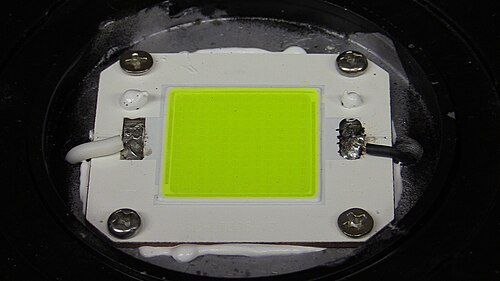
COB. Dozens to hundreds of bare dies are attached directly to an aluminium or ceramic substrate, wired in series-parallel strings, surrounded by a dam ring and covered with one pool of phosphor silicone. The light-emitting surface (LES) is typically 6–30 mm across.
CSP. A flip-chip die has both electrodes underneath, so it needs no bond wires. Phosphor is coated directly onto its top and sides, and the result, barely larger than the die itself (by convention no more than about 20% larger in area), is soldered straight to the board.
Interactive diagram: DIP, SMD and COB cross-sections compared
COB vs SMD vs CSP at a glance
Mid-power SMD LEDs give the lowest cost per lumen and spread heat across many small sources. COB gives one bright, uniform surface with a single crisp shadow but concentrates heat. CSP is the smallest and has the shortest heat path, which suits compact optics, headlamps and backlights.
| Property | SMD (mid-power) | COB | CSP |
|---|---|---|---|
| Construction | Packaged die on a lead frame | Many bare dies on one substrate | Flip-chip die with phosphor, no package |
| Size | 2–6 mm per package | 6–30+ mm emitting surface | 1–1.5 mm |
| Power per unit | 0.1–1 W (1–3 W high-power) | 3–200 W+ | 0.2–3 W |
| Efficacy | 150–220 lm/W | 100–180 lm/W | 130–200 lm/W |
| Heat path | Thermal pad to board | Substrate straight to heat sink | Direct solder to board (shortest) |
| Beam and shadows | Many points; multi-shadows without a diffuser | One source; single crisp shadow | Tiny, intense point for small optics |
| Color uniformity | Good with tight binning | Excellent across the surface | Good; edges can look bluish |
| Cost per lumen | Lowest | Low to moderate | Moderate |
| Typical uses | Bulbs, tubes, panels, strips, high-bays | Downlights, spots, track, stage | Headlamps, flashes, backlights, dense arrays |
Heat: where the watts go
Roughly half or more of the electrical power entering a white LED leaves as heat at the junction. SMD arrays spread that heat across a board, COBs concentrate tens of watts in a few square centimetres, and CSPs pass it through the shortest path, straight into the circuit board.
In an SMD fixture, heat flows from each die through its thermal pad, solder, copper, the board's dielectric layer and its aluminium core into the heat sink. Because the sources are spread out, each one only has to shed a fraction of a watt. A COB has no package or solder layer between die and substrate, but its heat is concentrated: a 100 W module may need to shed 60 W or more from an area the size of a large coin, so it needs a substantial heat sink and a thin, well-applied thermal interface material. A CSP sits directly on the board with almost nothing in between, which gives the lowest thermal resistance of all, provided the board itself can spread the heat.
In every case the goal is the same: keep the junction temperature well below its rated maximum, because light output, color stability and lifetime all fall as it rises.
Beam, shadows and glare
A COB behaves like one bright disc, so it casts a single crisp shadow and pairs well with reflectors for clean spot beams. SMD arrays act as many points and can cast multiple shadows without a diffuser. CSPs are tiny, intense points that let designers use very small optics.

Retail and museum spotlights favor COB because the single source produces smooth, round beams and clean shadows, and its high-CRI versions (Ra 95–98) render merchandise and artwork well. The flip side is luminance: a bare COB is dazzling, so good fixtures recess it deeply or use honeycomb louvres to control glare.
Panels, troffers and bulbs use mid-power SMD arrays behind diffusers, which turn many points into one soft surface at the cost of 5–20% of the light. Where a designer needs a very small, very bright source, as in headlamp projectors, camera flashes, flashlights and direct-lit TV backlights, CSP and high-power ceramic SMD packages win because the optic can be tiny.
Reliability and failure modes
All three last for tens of thousands of hours when kept cool and driven correctly. Their weak points differ: SMD housings can yellow and silver lead frames can tarnish, COB strings can fail as a group, and CSP solder joints carry all the mechanical stress because there are no leads.
- SMD: PPA housings yellow under heat and blue light; silver-plated lead frames blacken if sulfur from rubber seals or polluted air gets in; overdriven budget parts fade quickly.
- COB: one module carries all the light, so a die failing open can darken a whole string, and a poor thermal interface quickly overheats the entire array.
- CSP: no bond wires to break, but solder joints absorb all thermal-expansion stress; board flatness and reflow quality are critical.
Lifetime ratings and test methods for all three are explained in LED lifespan: L70, LM-80 and TM-21.
COB and CSP LED strips
COB LED strips pack 320 to more than 500 tiny dies per metre under a continuous phosphor line, giving a smooth, dotless line of light without a diffuser. They look best in coves and glossy reflections, but are usually slightly less efficient and run warmer than a quality 2835 strip.
"CSP strips" use rows of small chip-scale packages and fall between the two: fewer visible dots than an SMD strip, with somewhat better heat handling than a COB strip. For long runs, the same rules apply as for any strip: aluminium channel, 24 V where possible, and power fed from both ends. Strip chips are compared in SMD 2835 vs 5050 vs 3030.
Which package should you choose?
Choose COB for spotlights, track and museum lighting where one crisp beam matters. Choose mid-power SMD for bulbs, tubes, panels and high-bays where cost per lumen and efficiency matter. Choose CSP or high-power ceramic LEDs for compact optics such as headlamps, flashlights and backlights.
- Accent, track, retail and museum spots: COB, ideally Ra 95+ with high R9.
- General lighting at the lowest cost per lumen: mid-power SMD (2835 or 3030).
- Headlamps, flashlights, camera flashes and backlights: CSP or high-power ceramic SMD.
- Seamless lines of light: COB or CSP strips in an aluminium channel.
Frequently asked questions
Is COB better than SMD?
For tight beams, a single clean shadow and color uniformity, yes. For efficacy, cost per lumen and spreading heat, SMD usually wins. Many quality spotlights use COB, while most panels, tubes and bulbs use SMD.
What is a CSP LED?
A chip-scale package: a flip-chip LED die with phosphor applied directly to it and no lead frame or bond wires, so the package is barely larger than the die.
Why do COB LEDs need big heat sinks?
Tens of watts of heat leave an area a few centimetres across. Without a large heat sink the junction overheats, the light dims and the module's life is shortened.
Are COB LED strips better than SMD strips?
They look better where the strip is visible or reflected, because the line has no dots, but they are usually a little less efficient and run warmer than a quality 2835 strip of the same output.
Do COB lights flicker more than SMD lights?
No. Flicker depends on the driver, not the package. See LED drivers and flicker.
Sources and further reading
- IES LM-80-20 and ANSI/IES TM-21-21, lumen-maintenance testing and projection for LED packages, arrays and modules, Illuminating Engineering Society (IES).
- JEDEC JESD51-50, -51 and -52, thermal measurement methods for LEDs.
- IEC 62031:2018 (LED modules: safety) and IEC 62717 (LED modules: performance requirements).
- U.S. DOE, "Solid-State Lighting R&D Opportunities" (2022), LED packaging and reliability.
- Manufacturer datasheets and application notes: Lumileds LUXEON FlipChip and LUXEON Rebel; Cree XLamp CXB; Bridgelux Vero; Citizen CLU series.
Image credits
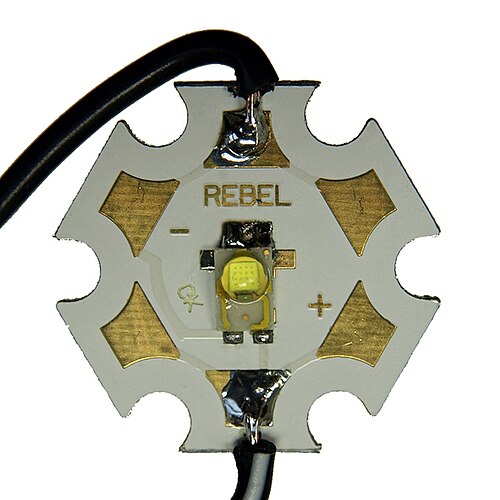
- 100 W COB LED: Antonireykern, CC BY-SA 4.0. COB module: Binarysequence, CC BY-SA 4.0. LUXEON Rebel: Kiu77, CC BY-SA 3.0. All via Wikimedia Commons. Diagram: LEDlights.org.