LED applications
How LEDs light homes, cities, screens, vehicles, farms and hospitals, and what to look for in each
LEDs are now the default light source for almost every application, because they are efficient (100–220 lm/W), long-lived, instantly controllable, small and available in any wavelength from UV-C to infrared. Each application values a different mix of these strengths, so the right LED for a grow room, a headlamp or a living room is very different.
Residential lighting
In homes, LEDs replace every traditional bulb shape, from A19 table-lamp bulbs and BR30 recessed floods to GU10 and MR16 spots, and add strip lighting for coves and cabinets. Choose by lumens, keep one color temperature per room, use CRI 90+ where color matters, and pair dimmable lamps with LED-rated dimmers.
Bulb shapes and bases
LED lamps copy the shapes they replace. The shape code gives the profile and diameter in eighths of an inch, so an A19 is 2⅜ inches across, and the base code gives the type and size in millimeters, so E26 is a 26 mm Edison screw. An 800-lumen A19 replaces a 60 W bulb.
The table covers the lamps found in most homes. Every other shape and base, with diameters, metric names and pin spacings, is listed in the LED bulb shapes and bases guide.
| Lamp | Shape | Common base | Typical LED | Replaces | Best for |
|---|---|---|---|---|---|
| A19 | Standard "arbitrary" bulb, 2⅜″ | E26 (E27 in Europe) | 8–9 W, 800 lm | 60 W | Table and floor lamps, general fixtures |
| BR30 | Bulged reflector, 3¾″ | E26 | 8–11 W, 650–850 lm | 65 W | Recessed cans in living spaces and kitchens |
| PAR38 | Parabolic aluminized reflector, 4¾″ | E26 | 13–18 W, 1,100–1,500 lm | 90–120 W | Outdoor floods, security, high ceilings (wet-rated) |
| GU10 | 50 mm reflector spot | GU10 twist-lock (line voltage) | 5–7 W, 350–550 lm | 35–50 W halogen | Track and accent lights, kitchens (common in Europe) |
| MR16 | Multifaceted reflector, 2″ | GU5.3 bi-pin (12 V) | 5–7 W, 400–500 lm | 35–50 W halogen | Low-voltage track and landscape lighting (check transformer compatibility) |
| B11 / CA10 | Candle / torpedo | E12 candelabra | 4–5 W, 300–500 lm | 40 W | Chandeliers, sconces, often as filament LEDs |
When buying, compare lumens, not watts. Choose a CCT (2700 K warm, 3000 K soft white, 4000 K neutral) and use the same one in each room. Look for CRI 90+ in kitchens and bathrooms, "enclosed-fixture rated" for closed globes, and "damp/wet rated" outdoors.
Cove, under-cabinet and strip lighting
LED strips bring architectural lighting into homes: coves, toe-kicks, under-cabinet task light, stairs and TV bias lighting. For a quality result, use 24 V high-density or dotless COB strips in aluminum channels with diffusers, load the power supply to 80% or less, and feed long runs from both ends.
LED strips made architectural lighting affordable for homes: cove uplighting, toe-kicks, under-cabinet task light, stair treads and TV bias lighting. For quality results, choose 24 V strips with high LED density (or dotless COB strips), mount them in an aluminium channel for heat and a clean look, use a diffuser to hide hot spots, size the power supply at 80% load or less, and feed long runs from both ends to avoid voltage-drop dimming. Under-cabinet lights should be 3000–4000 K with CRI 90+ for food preparation.
Circadian and human-centric lighting
Melanopsin cells in the eye, most sensitive to cyan-blue light near 480–490 nm, set the body clock. Bright, cooler light by day supports alertness, while bright, cool light late in the evening can delay melatonin. Tunable-white and dim-to-warm LEDs let homes follow this rhythm, measured as melanopic EDI under CIE S 026.
Light does more than let us see. Intrinsically photosensitive retinal ganglion cells (ipRGCs) containing melanopsin, most sensitive near 480–490 nm (cyan-blue), signal the brain's clock. Bright, blue-enriched light in the morning supports alertness and a stable sleep–wake rhythm, while bright, cool light late in the evening can delay melatonin release. Standards now quantify this with melanopic EDI (CIE S 026) and recommendations like at least ~250 melanopic lux at eye level during the day and less than 10 at night. Tunable-white fixtures (2700–6500 K) and dim-to-warm lamps, which warm toward 1,800–2,200 K as they dim like a filament, make circadian-friendly lighting practical at home.
Dimmer compatibility
Old incandescent dimmers often need a minimum load of 40 W or more, which a few LED bulbs cannot provide, causing flicker, buzzing or a faint glow when off. Use dimmers labeled LED/CFL or trailing-edge ELV, adjust the low-end trim, and check the bulb maker's compatibility list.
An old incandescent dimmer may need a minimum load of 40 W or more, which a few LED bulbs cannot provide, causing flicker, buzzing or "ghosting" when off. Use dimmers labelled LED/CFL or ELV/trailing-edge, set the low-end trim, and check the bulb maker's compatibility list.
Commercial, industrial and municipal
Commercial, industrial and municipal lighting switched early to LEDs because it runs for long hours. Offices replace fluorescent troffers with panels and tubes, warehouses swap metal-halide high-bays for LED, and cities convert streetlights and traffic signals, typically cutting lighting energy by 50–70% with payback in one to three years.
Offices, schools and retail
Offices and schools replace fluorescent troffers and T8 tubes with LED flat panels, retrofit kits or TLED tubes. A three-lamp troffer drawing about 85 W is typically replaced by a 30–40 W LED panel, and adding occupancy and daylight sensors often doubles the savings. Retail adds high-CRI COB track spots.
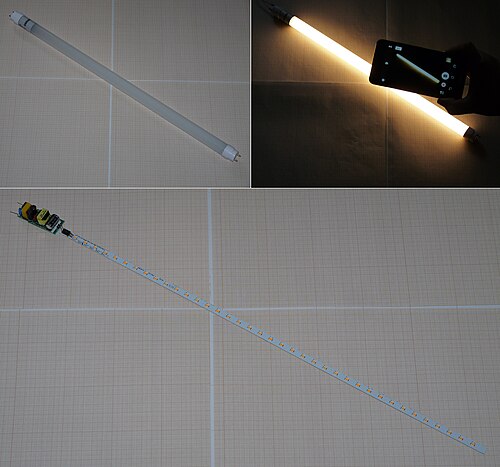

Fluorescent troffers (2 × 4 ft and 2 × 2 ft) and linear T8/T5 fixtures dominated offices for 50 years. LED replacements come as edge-lit or back-lit flat panels, troffer retrofit kits, and TLED tubes. Type A tubes run on the existing ballast, Type B bypass the ballast and run on mains, and Type C use a remote driver. A three-lamp T8 troffer drawing ~85 W is typically replaced by a 30–40 W LED panel with equal or better light. Adding occupancy and daylight sensors, as many energy codes now require, often doubles the savings. Retail lighting adds high-CRI (90–98) COB track spots to make merchandise look its best.
High-bays and warehouses
Warehouses with 20–40 ft ceilings are replacing 400 W metal-halide high-bays with 100–240 W LED fixtures that deliver 15,000–35,000 lumens. LEDs switch on instantly, dim to 10–20% in empty aisles with motion sensors, and last 50,000–100,000 hours, cutting both energy and lift-truck maintenance.
Spaces with 20–40 ft ceilings once used 400 W metal halide high-bays that took minutes to warm up and restrike and lost a third of their output by mid-life. Round "UFO" or linear LED high-bays at 100–240 W deliver 15,000–35,000 lm, switch on instantly, work with motion sensors (empty aisles can dim to 10–20%), and last 50,000–100,000 hours, which cuts lift-truck maintenance costs.
Stadiums and sports lighting
Sports venues need 2,000–3,000+ lux of vertical light for broadcast, high color rendering and tight glare control. LED floodlights cut energy use by 50–75% compared with metal halide, are flicker-free for slow-motion replays and switch on instantly, which enables light shows between periods.
Sports lighting has some of the most demanding specifications in the industry: vertical illuminance of 2,000–3,000+ lux for broadcast, high CRI and TLCI for cameras, uniformity ratios, and glare control for players. LED floodlights of 1,000–2,000 W each replaced 1,500–2,000 W metal-halide units, cutting energy use by 50–75%. More importantly, they are flicker-free for ultra-slow-motion replays and instant-on, so venues can run between-period light shows synchronized to music. That is impossible with metal halide, which needs 10–15 minutes to restrike.
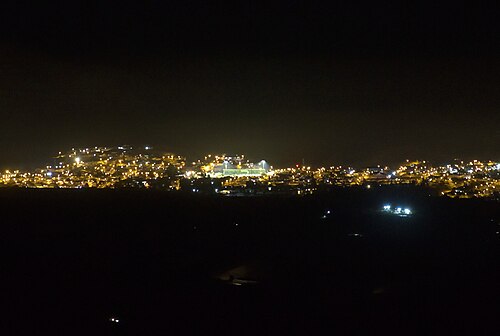

Streetlights
Cities have replaced sodium streetlights with LEDs that aim light onto the road with far less spill; Los Angeles cut streetlight energy by over 60%. Current guidance from the American Medical Association and dark-sky groups calls for 3,000 K or lower, full cut-off shielding and late-night dimming.
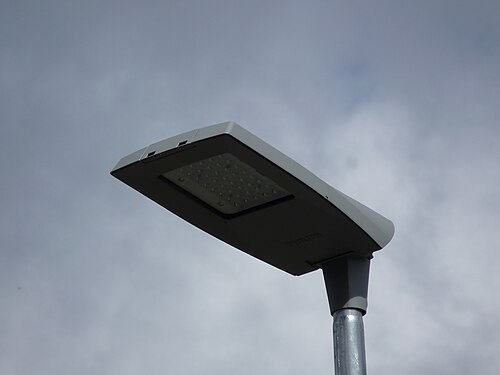

Cities worldwide have replaced high-pressure sodium (HPS) cobra-heads with LED. The City of Los Angeles replaced more than 140,000 streetlights in the late 2000s and early 2010s, cutting streetlight energy use by over 60%. LED optics put light where it is needed with far less spill, and networked controls allow dimming late at night, fault reporting and smart-city sensors.
The first LED streetlights were often 4,000–5,000 K and harsh. Today the American Medical Association (2016) and dark-sky guidance recommend 3000 K or lower, full cut-off shielding and adaptive dimming to limit glare, skyglow and harm to wildlife. Sea-turtle nesting beaches and observatory zones use amber (~590 nm) or phosphor-converted amber LEDs.

Traffic signals
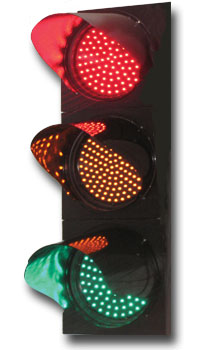
Traffic signals were an ideal early LED market because an incandescent signal wastes most of its light in a colored filter. An LED red signal draws about 10 W instead of 69–150 W, lasts 5–10 years and fails gradually, although it produces too little heat to melt snow.
Traffic signals were an ideal early LED market. An incandescent signal wastes most of its light in a colored filter and burns out every year or so, while an LED module makes only the needed color. A typical LED red ball draws ~10 W instead of 69–150 W, lasts 5–10 years, and fails gradually rather than going dark. In the U.S., the Energy Policy Act of 2005 effectively required LED-level efficiency for new traffic and pedestrian signals. One known drawback is that LEDs produce little waste heat, so signals in snowy regions can be covered by snow. Heated lenses or visors are the fix.
The savings math: a worked example
Replacing 30 metal-halide high-bays drawing 455 W each with 150 W LED fixtures, run 4,000 hours a year at $0.12 per kWh, saves 36,600 kWh and about $4,392 a year, a 67% cut. Avoided relamping, sensors and rebates typically bring payback to one to three years.
A warehouse has 30 metal-halide high-bays at 400 W, each drawing about 455 W including the ballast, operating 4,000 hours a year at $0.12/kWh. It replaces them with 150 W LED high-bays.
New: 30 × 150 W × 4,000 h = 18,000 kWh/yr → $2,160
Savings: 36,600 kWh and ≈ $4,392 per year (−67%)Not counted: avoided relamping (MH lamps every ~2–3 years at these hours, plus lift rental), lower cooling load, and further savings of 20–40% from occupancy sensors. Utility rebates often cover a large share of the fixture cost, so typical payback is 1–3 years.
Try your own numbers in the energy savings calculator.
Specifying LED lighting: lux, beam angle and IP rating
Specify LED lighting with three numbers: target illuminance in lux, such as 300–500 lux for offices and classrooms; a beam angle that suits mounting height and spacing; and an IP rating matched to the location, such as IP44 near splashing water and IP65 or higher outdoors.
Three numbers decide whether a lighting design works: how much light reaches the task (illuminance, in lux), how the light is spread (beam angle), and whether the fixture survives its environment (IP rating). Get these right before choosing brands or styles.
Recommended light levels (lux)
Recommended maintained light levels are about 50–150 lux for corridors and garages, 100–300 lux for living rooms, 300–500 lux for offices and classrooms, 300–750 lux for kitchen counters and retail, and 750–1,500 lux for detailed work. Surgical fields need 40,000–160,000 lux under IEC 60601-2-41.
One lux is one lumen per square metre; one foot-candle is about 10.76 lux. Recommended levels below follow EN 12464-1 (indoor workplaces) and IES practice. They are maintained values: designers aim 25–40% higher at installation to allow for lumen depreciation and dirt, and older eyes need roughly twice as much light as younger ones for the same task.
| Space or task | Lux | Foot-candles |
|---|---|---|
| Corridors, stairs, parking garages | 50–150 | 5–15 |
| Living rooms and bedrooms (ambient) | 100–300 | 10–30 |
| Warehouses and storage aisles | 100–300 | 10–30 |
| Classrooms | 300–500 | 30–50 |
| Kitchen countertops, reading, bathroom mirrors | 300–750 | 30–70 |
| Offices and computer work | 300–500 | 30–50 |
| Retail sales floors | 300–750 | 30–70 |
| Detailed assembly, drawing, inspection | 750–1,500 | 70–140 |
| Hospital examination | 1,000 | ~90 |
| Professional sports, broadcast (vertical) | 1,500–3,000+ | 140–280+ |
| Surgical field (IEC 60601-2-41) | 40,000–160,000 | 3,700–15,000 |
A quick estimate for a room: required lumens ≈ area (m²) × target lux ÷ 0.6, where 0.6 roughly accounts for light lost to walls, ceilings and fixture optics. A 20 m² office at 500 lux needs about 16,700 lumens from its fixtures.
Beam angles and spacing
The beam angle is the angle within which intensity stays above half the center value. Narrow 10–15° spots suit artwork and high ceilings, 24–25° spots accent lighting, 36–40° beams general downlighting, and 60° or wider floods ambient light. The diameter of the pool of light is 2 × distance × tan(half the beam angle).
The beam angle is the angle between the two directions where intensity falls to 50% of the centre value. A narrow beam concentrates the same lumens into a smaller, brighter pool; a wide beam gives soft, even light. The diameter of the pool at distance d is:
| Beam angle | Name | Pool at 3 m | Typical use |
|---|---|---|---|
| 10–15° | Narrow spot | 0.5–0.8 m | Artwork, sculptures, high ceilings, façade grazing |
| 24–25° | Spot | ~1.3 m | Accent lighting, retail displays, kitchen islands |
| 36–40° | Narrow flood | 1.9–2.2 m | General downlighting in homes, track lighting |
| 60° | Flood | ~3.5 m | Ambient downlights, low ceilings, garages |
| 90–120° | Wide flood | 6–10 m | Panels, troffers, high-bays in open areas, strips |
For even general lighting, a common rule of thumb is to space recessed downlights about half the ceiling height apart (roughly 1.2 m on a 2.4 m ceiling) and half that distance from the walls. Wide-beam fixtures can go further apart; narrow beams need closer spacing. Use spots for drama and contrast, and floods for uniform task and ambient light.
IP ratings: dust and water protection
An IP code under IEC 60529 has two digits: the first rates protection against solids and dust from 0 to 6, the second against water from 0 to 9. Use IP20 in dry indoor spaces, IP44 near splashing water, IP65 or IP66 outdoors, IP67 for in-ground lights and IP68 underwater.
An IP (ingress protection) code under IEC 60529 has two digits: the first (0–6) rates protection against solids and dust, the second (0–9) against water. Higher is not always "better" in every way: an IP68 fixture is tested for submersion, but that says nothing about resistance to high-pressure jets (IPX5/X6) unless both are listed.
| Rating | Solids | Water | Typical LED use |
|---|---|---|---|
| IP20 | Fingers (≥12.5 mm) | None | Indoor dry locations, drivers in ceilings |
| IP44 | Wires (≥1 mm) | Splashing from any direction | Bathrooms outside the shower zone, covered porches |
| IP54 | Dust-protected | Splashing | Workshops, sheltered outdoor fixtures |
| IP65 | Dust-tight | Low-pressure water jets | Outdoor walls and soffits, shower ceilings, covered parking |
| IP66 | Dust-tight | Powerful water jets | Floodlights, streetlights, food-processing plants |
| IP67 | Dust-tight | Temporary immersion (up to 1 m, 30 min) | In-ground uplights, outdoor strips, pathway lights |
| IP68 | Dust-tight | Continuous immersion (conditions set by maker) | Pool, pond, fountain and underwater lights |
| IP69K | Dust-tight | High-pressure, high-temperature washdown | Vehicle lamps (ISO 20653), food and beverage plants |
Bathrooms are divided into zones in IEC 60364-7-701 and the UK wiring regulations: inside the bath or shower (zone 0) needs IPX7 and extra-low voltage (typically 12 V), the area directly above it (zone 1) at least IPX4 (many specify IP65), and the surrounding zone 2 at least IPX4. North America instead lists fixtures for damp or wet locations under UL 1598. LED strips rated IP65 have a silicone coating; IP67 and IP68 strips are fully encased in silicone tube or resin.
Displays and signage
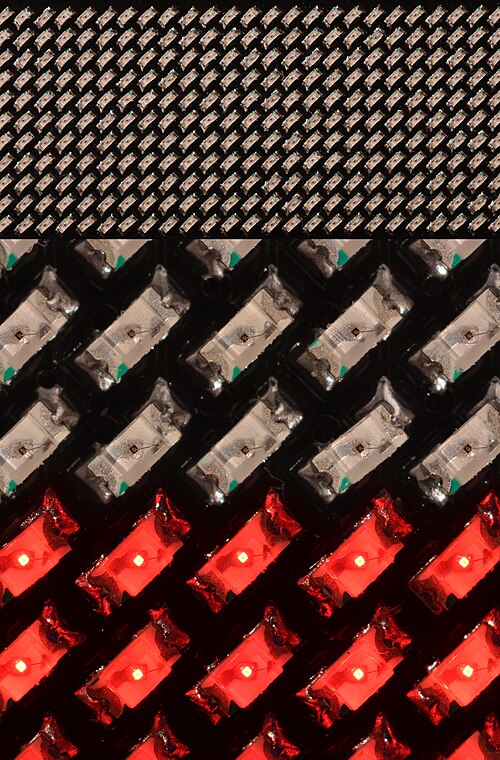
LEDs now create nearly every modern screen. Phones and watches use self-emissive AMOLED, televisions use LED-backlit LCDs, quantum-dot "QLED," Mini-LED or OLED, and stadium boards, billboards and virtual-production stages use direct-view LED video walls rated by pixel pitch and brightness in nits.

Phones, watches and laptops
Almost every premium smartphone and smartwatch uses an AMOLED display, in which each sub-pixel is an organic LED, giving true blacks, thin flexible panels and always-on displays. LTPO backplanes drop the refresh rate to 1 Hz for static content, while laptops and tablets use LCDs, Mini-LED or tandem OLED.
Almost every premium smartphone and smartwatch uses an AMOLED display. Each sub-pixel is an organic LED, giving true blacks, thin flexible panels and always-on displays that light only a few pixels. LTPO backplanes drop the refresh rate to 1 Hz for static content to save battery. Laptops and tablets use LED-backlit LCDs, Mini-LED backlights for HDR, or tandem OLED.
Televisions
An "LED TV" is an LCD with an LED backlight. QLED adds a quantum-dot film for wider color, Mini-LED uses thousands of tiny LEDs in local-dimming zones for bright HDR, OLED makes light in every sub-pixel for perfect black, and MicroLED does the same with inorganic LEDs at very high cost.
| TV technology | How the light is made | Strengths | Weaknesses |
|---|---|---|---|
| "LED TV" (LED-backlit LCD) | White LEDs (edge or direct) behind an LCD | Cheap, bright, no burn-in | Grey blacks, limited contrast |
| QLED | Blue LEDs + quantum-dot film + LCD | Wide color gamut, high brightness | Still LCD contrast unless combined with Mini-LED |
| Mini-LED | Thousands of tiny LEDs in hundreds to thousands of dimming zones | Very bright HDR (1,000–3,000+ nits), deep blacks | Blooming halos around bright objects |
| OLED (WOLED / QD-OLED) | Self-emissive organic sub-pixels | Perfect black, per-pixel contrast, wide viewing angle | Lower full-screen brightness, burn-in risk with static content |
| MicroLED | Self-emissive inorganic micro-LEDs | Perfect black and very high brightness, no burn-in | Extremely expensive today |
LED video walls and signage
Direct-view LED video walls build images from modular RGB LED panels rated by pixel pitch, the spacing between pixels in millimeters: P10–P4 for billboards, P3–P1.5 for retail and events, and under P1.2 for control rooms. Outdoor signs run at 5,000–10,000 nits; indoor walls need only 600–1,500.
Direct-view LED video walls build images from modular panels of RGB LEDs. Their key spec is pixel pitch, the distance between pixel centres in millimetres: P10–P4 for billboards and stadium boards, P3–P1.5 for retail and events, and below P1.2 ("fine pitch", Mini/MicroLED) for control rooms and corporate lobbies. A common rule of thumb is that the minimum comfortable viewing distance in metres is about the pitch in millimetres, and the ideal distance is 2–3 times that. Outdoor signs run at 5,000–10,000 nits to beat sunlight, while indoor walls need only 600–1,500 nits.
LED walls also enabled virtual production. Film and TV sets shoot actors in front of curved LED volumes that display real-time 3D environments, providing realistic reflections and lighting in-camera. At the extreme end, the Las Vegas Sphere (2023) wraps its exterior in about 1.2 million LED pucks and lines its interior with a 16K-resolution LED screen.
Automotive lighting
LEDs now light almost every part of a car: headlamps, daytime running lights, brake lights, turn signals and interiors. They react in under a millisecond, can last the life of the vehicle, allow compact styled lamps and matrix high beams, and define brand identity through signature light shapes.
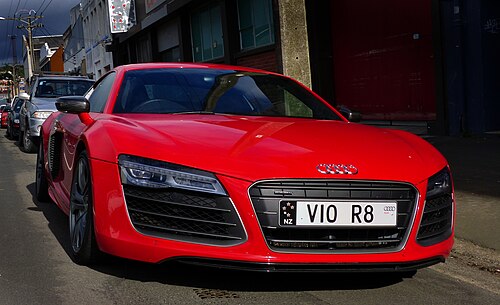

Cars were among the first places LEDs replaced bulbs: dashboard indicators in the 1980s, then the center high-mounted stop lamp (CHMSL), tail lights, interior lights and, from the late 2000s, headlamps. Today LED lighting is standard on most new vehicles, and it also defines brand identity through signature DRL shapes.
LED and matrix headlights
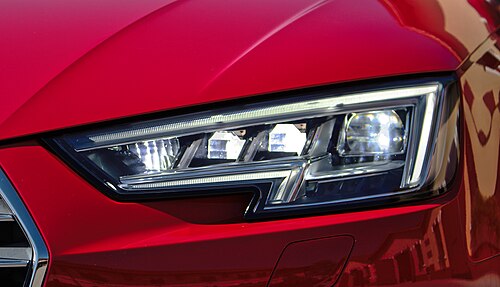
The Lexus LS 600h offered the first LED low beams in 2007 and the Audi R8 the first full-LED headlamps in 2008. Matrix, or adaptive driving beam, headlights split the high beam into individually switched segments, and a camera turns off only those that would dazzle other drivers.
The Lexus LS 600h (2007) offered the first LED low beams, and the Audi R8 (2008) the first full-LED headlamps. LEDs allow compact, styled headlamps with crisp cut-offs and a daylight-like 5,500–6,000 K color that improves contrast. Matrix (adaptive driving beam, ADB) headlights, introduced by Audi on the 2013 A8, split the high beam into dozens to hundreds of individually controlled LED segments. A camera detects oncoming and preceding vehicles and switches off only the segments that would dazzle them, so drivers can keep the high beam on almost all the time. "Digital" headlamps with over a million pixels, based on DMD chips or micro-LED arrays, can even project lane markings and warning symbols onto the road. In the U.S., NHTSA's 2022 final rule allowed ADB systems.


Daytime running lights (DRL)
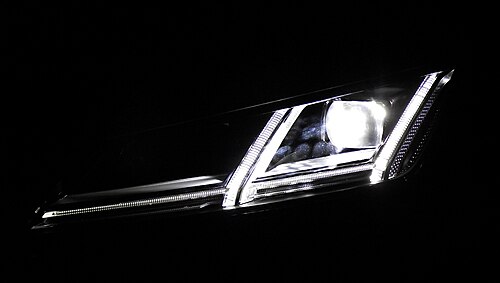
Daytime running lights make vehicles easier to see in daylight and have been mandatory on new cars in the EU since 2011. An LED DRL draws only 5–10 W, compared with 50–110 W for running halogen low beams, and its light guides have become a styling signature.
DRLs make vehicles more conspicuous in daylight. They have been mandatory on new cars in the EU since 2011, and an LED DRL draws only 5–10 W, compared with 50–110 W for running low-beam halogens. Their light guides and LED strips have become a styling signature.
Brake lights and sequential turn signals
LED brake lights reach full brightness in under a millisecond, about 200 ms faster than a filament bulb, giving a following driver roughly 5–6 meters of extra stopping distance at 100 km/h. LEDs also made sequential turn signals, which sweep in the direction of the turn, practical and legal.
LED brake lights reach full brightness in under a millisecond, compared with about 200 ms for an incandescent filament. At 100 km/h (62 mph) that extra warning gives a following driver roughly 5–6 metres more stopping distance. LEDs also made sequential ("dynamic") turn signals practical. They sweep outward in the direction of the turn and are permitted under UN ECE Regulation 48 and in the U.S., echoing the mechanical sequential signals of the 1965 Ford Thunderbird.
LED replacement bulbs: what to know
LED replacement bulbs for interior, plate and signal lights are usually simple swaps, but headlamp bulbs need care. The beam pattern matters more than lumens, plug-in LED bulbs in halogen housings are generally not FMVSS 108 compliant in the U.S., and cooling, CANbus errors and color must all be checked.
Aftermarket LED bulbs for interior lights, license plates, reverse lights and signals are popular and usually straightforward. Headlamp replacements need more care:
- Beam pattern is what matters, not lumens. A reflector or projector housing is designed around the exact position of a halogen filament. An LED bulb whose emitters do not sit in the same spot scatters glare at oncoming drivers and leaves dark patches. Look for thin emitter boards that copy the filament's size and position, and aim the headlamps after installation.
- Legality varies. In the U.S., plug-in LED bulbs in halogen housings are generally not FMVSS 108 compliant. Complete DOT-compliant LED headlamp assemblies are the legal route. Several European countries now approve specific LED retrofit bulbs for listed vehicle models.
- Cooling. Headlight LEDs dissipate 15–30 W in a tiny space and use aluminium heat sinks, braided copper straps or small fans. Check that there is room behind the headlamp and that the dust cap fits.
- CANbus and hyper-flash. Modern cars monitor bulb current. Lower-power LEDs can trigger "bulb out" warnings or rapid flashing of turn signals. "CANbus-ready" bulbs, load resistors or a compatible flasher relay solve this.
- Color. Choose 5,500–6,500 K for headlights. Blue-tinted "8,000 K+" bulbs reduce usable light in rain and may be illegal. Amber and red signal LEDs must meet the same color rules as the bulbs they replace.
Example: complete LED headlamps and tail lights
Besides plug-in bulbs, the aftermarket sells complete LED lamps that replace the whole headlamp or tail light. A complete LED headlamp has its own emitters, optics, heat sink and driver, so its beam is designed around the LEDs. LED tail lights group red, amber and white LEDs and light guides in one housing.
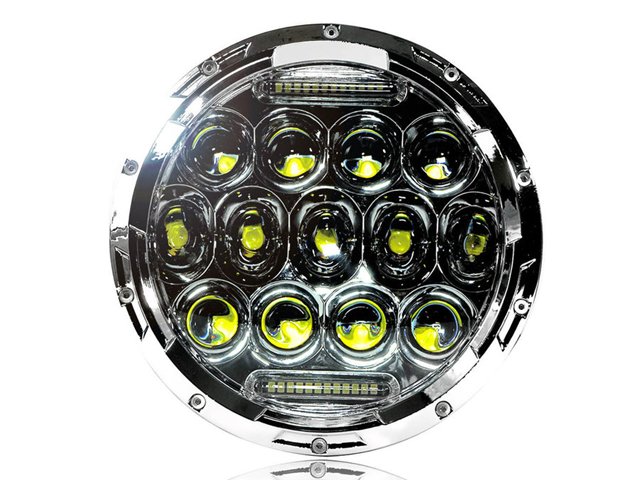
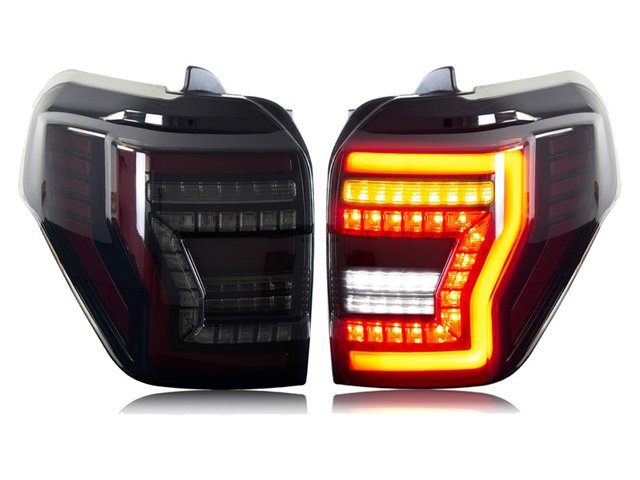
Both lamps come from GENSSI, an automotive lighting brand under the same ownership as LEDlights.org. They put the points above into practice: the headlamp is built around its LEDs instead of fitting an LED bulb into a reflector designed for a halogen filament, and the tail light gives the brake, turn and reverse functions their own LEDs, which reach full brightness in under a millisecond. As with any aftermarket lamp, check that the model is approved for road use where you drive (DOT and SAE markings in the U.S., an E-mark in Europe) and aim the headlamps after fitting.
Interior and ambient lighting
Car interiors use addressable RGB LEDs and light guides for multi-color ambient lighting, illuminated trim and footwells. Dashboards and infotainment screens increasingly use OLED and Mini-LED displays, and some brands use OLED panels to create three-dimensional animated tail lights that can show warning patterns.
Multi-color ambient light strips, illuminated trim and RGB footwell lights use addressable LEDs and light guides. Dashboards and infotainment screens increasingly use OLED and Mini-LED, and some brands use OLED panels for three-dimensional tail-light animations.
Aviation
Airports use LED runway edge, centerline, taxiway and approach lights, which save energy and greatly reduce maintenance. Aircraft use LEDs for navigation lights, red on the left wingtip and green on the right, anti-collision strobes, landing lights and cabin mood lighting, and towers and wind turbines use LED obstruction lights.
Airfields have moved to LED runway edge, centreline, touchdown-zone and taxiway lights (green centreline, blue edges) and approach lighting systems, saving energy and greatly reducing maintenance on lights that sit in the runway surface. Aircraft use LEDs for navigation (position) lights (red on the left wingtip, green on the right, white at the tail), anti-collision strobes and beacons, landing and taxi lights, and cabin lighting. The Boeing 787 popularized color-changing LED mood lighting that eases jet lag. Obstruction lights on towers, wind turbines and tall buildings (red steady and flashing, and medium-intensity white strobes) are now almost all LED.
A notable challenge: LED airfield lights emit almost no infrared, while incandescent lights did. Some aircraft enhanced flight vision systems (EFVS) with infrared cameras can't "see" LED approach lights in fog. Airports and avionics makers are solving this with multispectral sensors and IR-emitting add-ons.
Marine
Boats must show navigation lights defined by the COLREGs: a white masthead light over 225°, red port and green starboard sidelights over 112.5° each, and a white sternlight over 135°. Certified LED navigation lights meet these arcs and ranges while drawing a fraction of the current, which matters on battery-powered boats.
Boats must show navigation lights defined by the international collision regulations (COLREGs): a white masthead light over a 225° arc, a red port and a green starboard sidelight each covering 112.5°, and a white sternlight over 135°, with minimum visibility ranges (for example 2 nautical miles for sidelights on vessels of 12–50 m). Certified LED navigation lights meet these arcs and ranges while drawing a fraction of the current, which matters on battery-powered sailboats. Lighthouses have been converted to LED lanterns, reducing maintenance at remote sites. Marine LEDs need corrosion-resistant housings, high IP ratings (IP67/68), and drivers that tolerate 9–32 V. Underwater LED lights, red night-vision cabin lighting and deck floods are standard in yachting and fishing.
Horticulture (grow lights)
Grow lights are measured in photons, not lumens. PPFD, in micromoles per square meter per second, is the light reaching the canopy, and the daily light integral is PPFD × hours × 0.0036. The best LED grow lights reach 2.7–3.1 µmol/J, far above the 1.7–1.9 of high-pressure sodium.
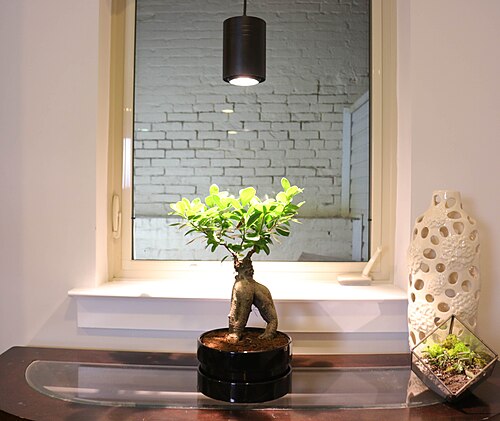

Plants are measured in photons, not lumens. Lumens are weighted for the human eye, which hardly sees the deep red and blue that plants use most. Horticulture uses these quantities:
- PAR (photosynthetically active radiation): the 400–700 nm band plants use for photosynthesis.
- PPF (µmol/s): total PAR photons a fixture emits per second.
- PPFD (µmol/m²/s): photons landing on the canopy, the plant equivalent of lux.
- DLI (daily light integral, mol/m²/day): the day's total, DLI = PPFD × hours × 0.0036.
- PPE / efficacy (µmol/J): photons per joule of electricity. Top LED fixtures reach 2.7–3.1+ µmol/J, against about 1.7–1.9 for double-ended HPS.
Spectrum: from "blurple" to full-spectrum white
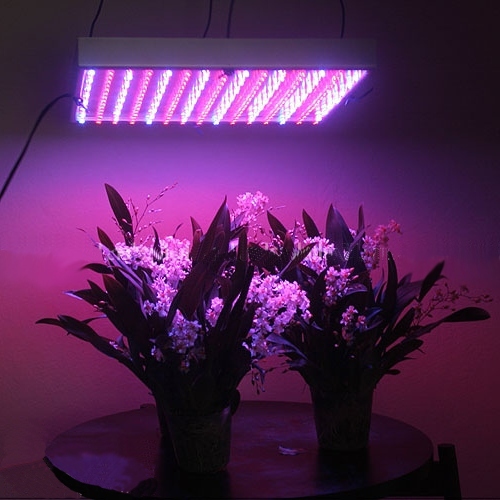
Early LED grow lights used only 660 nm red and 450 nm blue chips, giving a magenta "blurple" glow. Modern fixtures mostly combine full-spectrum white LEDs with extra 660 nm red, often adding 730 nm far-red for flowering and photosynthesis, which is efficient and lets growers see plants in true color.
Chlorophyll absorbs most strongly in the blue (~430–450 nm) and red (~640–665 nm). Early LED grow lights therefore used only 660 nm deep-red and 450 nm royal-blue chips, producing the familiar magenta "blurple" glow. These are efficient, but they make plants impossible to inspect and leave out green, which penetrates deeper into the canopy and still drives photosynthesis (the McCree curve). Modern fixtures mostly use full-spectrum white LEDs (3000–4000 K) plus extra 660 nm red, which is efficient, comfortable for workers and good for plant shape. Many add 730 nm far-red, which boosts photosynthesis together with red (the Emerson effect) and regulates stretching and flowering through phytochrome, and sometimes UV-A/UV-B to boost pigments and secondary metabolites.
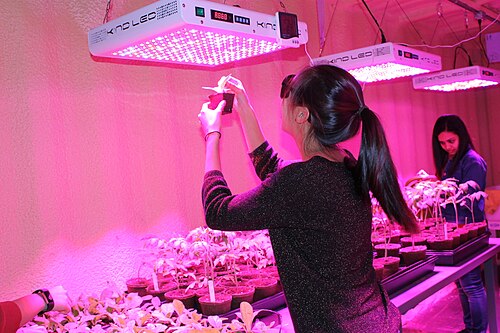




| Crop / stage | PPFD (µmol/m²/s) | Photoperiod | DLI (mol/m²/day) |
|---|---|---|---|
| Seedlings, clones, microgreens | 100–300 | 16–18 h | 6–15 |
| Lettuce and leafy greens | 200–400 | 16–18 h | 12–17 |
| Herbs (basil) | 300–500 | 16 h | 15–25 |
| Tomatoes, peppers, cucumbers | 400–700 | 14–18 h | 20–30 |
| High-light crops, flowering | 600–1,000+ | 12 h | 30–45+ |
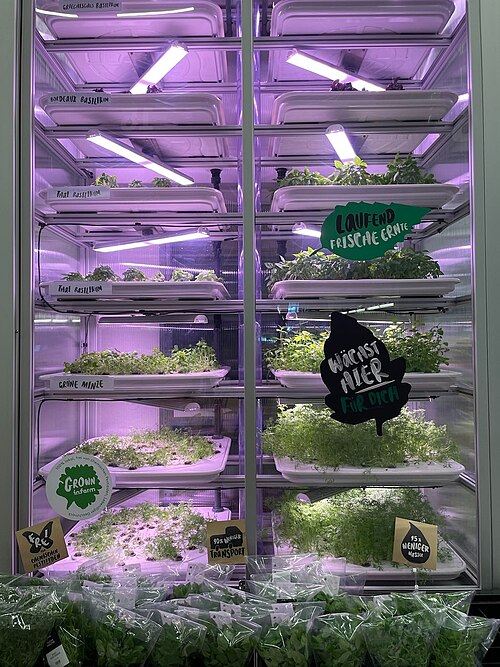
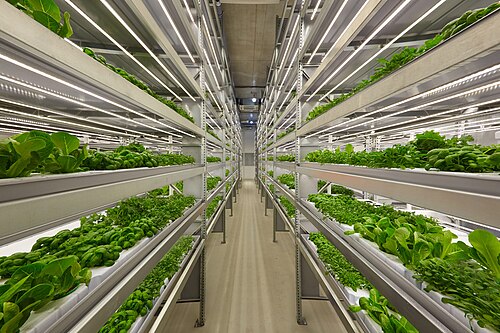
LEDs made vertical farming possible. Their cool emitting surface can sit centimetres above the plants in stacked racks, something hot HPS lamps cannot do. In greenhouses they supplement winter sunlight at a fraction of HPS energy use, and they can be dimmed to follow natural light.
Comparing grow lights: PPF, efficacy and PPFD maps
Compare grow lights by measured numbers, not watts or "equivalent" claims: total PPF in µmol/s, efficacy in µmol/J, and a PPFD map showing how evenly light lands on the canopy at a stated hanging height. A full-spectrum quantum meter, accurate across 400–700 nm, checks those claims in your own grow space.

Divide a fixture's PPF by its true power draw to get its efficacy: a 480 W fixture rated at 1,420 µmol/s delivers about 2.96 µmol/J. Ignore "1000 W equivalent" labels; many such lights draw about 100 W from the wall. A PPFD map is measured on a grid at a stated height, typically 30–45 cm (12–18 in) above the canopy, and its average and edge-to-centre ratio matter more than the peak reading under the middle of the fixture.
To check a light yourself, use a full-spectrum quantum sensor. Older silicon PAR sensors were calibrated for sunlight and under-read the deep red and over-read the blue of LED fixtures, so their readings under LEDs could be off by 10% or more. Measure at canopy height, at several points, with the room otherwise dark, and multiply the average PPFD by the photoperiod to check your DLI against the table above.
Medical and health
LEDs are used throughout medicine: red and near-infrared light for photobiomodulation, 460–490 nm blue for newborn jaundice, high-CRI white for surgical and examination lights, red and infrared pairs in pulse oximeters, blue for dental curing and UV-C for disinfection. They run cool, last long and allow precise wavelengths.
Photobiomodulation (red and near-infrared light therapy)
Photobiomodulation uses red and near-infrared light, usually 630–680 nm and 800–850 nm, at modest power to influence cell processes, probably through mitochondrial cytochrome c oxidase. Evidence is strongest for preventing oral mucositis during cancer treatment, with supportive evidence for some wound healing, pain and hair regrowth; dose matters.
Photobiomodulation (PBM), formerly "low-level light therapy", uses red and near-infrared light, usually 630–680 nm and 800–850 nm, at modest power to influence cellular processes. The leading proposed mechanism is absorption by cytochrome c oxidase in mitochondria. Evidence is strongest for preventing oral mucositis in patients receiving cancer therapy, which is recommended in international supportive-care guidelines, and there is supportive evidence for some wound healing, pain and musculoskeletal uses and for hair regrowth in androgenetic alopecia, with FDA-cleared devices available. Results for cosmetic skin rejuvenation are more mixed. Dose (fluence in J/cm²), wavelength and treatment schedule matter: more is not better.
Neonatal jaundice phototherapy
Newborns with high bilirubin are treated under blue light around 460–490 nm, matching bilirubin's absorption peak. The light converts bilirubin in the skin into water-soluble forms the baby can excrete. LED phototherapy units give intense, even irradiance with little heat and have largely replaced fluorescent and halogen units.
Newborns with high bilirubin are treated with blue light around 460–490 nm, matching bilirubin's absorption peak near 460 nm. The light converts bilirubin in the skin into water-soluble isomers (lumirubin) that the baby can excrete without needing the liver. LED phototherapy units deliver high, uniform irradiance (intensive therapy is typically ≥30 µW/cm²/nm) with little heat and long life, and have largely replaced fluorescent and halogen units.
Surgical and examination lights
Surgical lights must deliver 40,000–160,000 lux at the center of the field with CRI 85–100 and a CCT of 3,000–6,700 K under IEC 60601-2-41, plus shadow dilution and little heat. Premium LED surgical lights reach CRI 95+ with high R9 so tissue and blood look natural.
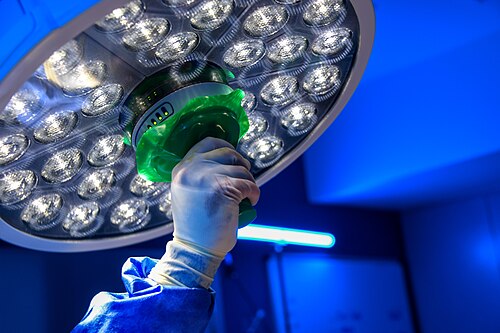

The surgical-light standard IEC 60601-2-41 requires a central illuminance of 40,000–160,000 lux, a color rendering index of Ra 85–100 and a CCT between 3,000 and 6,700 K, along with shadow dilution from many overlapping sources and limits on heat at the wound. Premium LED surgical lights reach Ra 95+ with high R9, so red tissue and blood look natural, stay cool for the surgeon and patient, and allow adjustable CCT (typically 3,500–5,000 K) to improve contrast between tissues. Dental curing lights use 450–470 nm blue LEDs to harden resin composites, and endoscopes, headlamps and exam lights are almost all LED.
Pulse oximetry
A pulse oximeter shines a red LED at about 660 nm and an infrared LED at about 905–940 nm through a fingertip. Oxygenated and deoxygenated hemoglobin absorb these wavelengths differently, so the ratio of the pulsing signals gives oxygen saturation, though accuracy can be lower for people with darker skin.
A pulse oximeter shines a red (~660 nm) and an infrared (~905–940 nm) LED through a fingertip or earlobe. Oxygenated and deoxygenated hemoglobin absorb these wavelengths differently, so the ratio of the pulsing signals gives oxygen saturation (SpO₂). Studies have shown reduced accuracy in people with darker skin pigmentation, which led the FDA to update its guidance on clinical testing.
UV-C disinfection
UV-C LEDs at 255–280 nm damage the DNA and RNA of bacteria and viruses so they cannot replicate. Compact, instant-on and mercury-free, they are used in point-of-use water purifiers, air-handling units and surface disinfection devices. Dose is measured in mJ/cm², and direct exposure harms eyes and skin.
UV-C LEDs at 255–280 nm damage the DNA and RNA of bacteria and viruses, stopping replication. Because they are compact, instant-on and mercury-free, they are used in point-of-use water purifiers, HVAC and air-handler modules, and surface disinfection devices for hospitals and labs. Effective dose is measured in mJ/cm², and direct exposure is hazardous to eyes and skin (see UV LEDs).
Telecom and sensing
Because LEDs switch millions of times per second, they carry data as well as light: in early and short-reach fiber links, plastic optical fiber in cars and audio gear, and Li-Fi networks. LEDs also power optocouplers, smoke detectors, proximity sensors, optical mice and strobed machine-vision lighting.
Fiber-optic communication
LEDs were the light sources of the first fiber-optic networks. 850 nm and 1,300 nm LEDs still drive some short-reach multimode links, and 650 nm red LEDs drive plastic optical fiber in cars and TOSLINK digital audio, while lasers dominate long-distance and high-speed links.
LEDs were the light sources of the first fiber networks. 850 nm and 1,300 nm LEDs still drive some short-reach multimode links, and 650 nm red LEDs drive plastic optical fiber (POF) in cars (the MOST bus) and TOSLINK digital audio. Lasers dominate long-distance and high-speed links.
Li-Fi and visible-light communication
Li-Fi sends data by modulating LED lighting faster than the eye can see. Standardized as IEEE 802.11bb in 2023, it suits hospitals, aircraft cabins, factories and secure sites where radio is restricted. Commercial access points deliver tens to hundreds of megabits per second, and lab links have exceeded 15 Gbit/s.
Because LEDs can switch on and off millions of times per second, faster than the eye can see, ordinary lighting can carry data. Li-Fi, popularized by Harald Haas from 2011 and standardized as IEEE 802.11bb in 2023, uses visible or infrared LEDs as optical Wi-Fi access points. It is valuable where radio is restricted or congested: hospitals, aircraft cabins, factories, secure facilities and underwater links. Commercial Li-Fi access points deliver tens to hundreds of megabits per second, while laboratory links using off-the-shelf LEDs and wavelength multiplexing have exceeded 15 Gbit/s.
Sensors and machine vision
LEDs are everywhere in sensing. Optocouplers pass signals across electrical isolation, photoelectric smoke detectors sense LED light scattered by smoke, machine-vision systems strobe colored LEDs in microseconds to inspect products, and phones, mice, barcode scanners and rain sensors all rely on small LED emitters.
- Optocouplers pair an IR LED and a photodetector to pass signals across electrical isolation in power supplies, motor drives and medical equipment.
- Photoelectric smoke detectors detect IR LED light scattered by smoke particles.
- Machine vision uses ring lights, bar lights, backlights and coaxial lights. Wavelength is chosen for contrast (red for barcodes, blue for scratches on metal, IR to see through some plastics), and LEDs are strobed in microseconds to freeze motion on production lines.
- Proximity, gesture and ambient-light sensors in phones, optical encoders, optical mice, barcode scanners, rain sensors on windshields, and LED-based gas and water-quality spectrometers.
Stage, DJ and entertainment lighting
Stage, club and DJ lighting went almost entirely LED in the 2010s. RGBW and RGBA wash lights mix saturated colors without gels, moving heads use 100–1,000 W white LED engines, and addressable pixel bars are mapped like video, all controlled over DMX512, Art-Net or sACN. High PWM frequencies prevent flicker on camera.
Concert, theatre, club and DJ lighting went almost entirely LED in the 2010s. LED PARs and wash lights mix RGBW, RGBA (amber) or RGBAL (adding lime) for saturated color and convincing whites with no gels. Moving heads combine white LED engines of 100–1,000 W with zoom optics, gobos and prisms. Pixel bars, strips and tubes built from addressable LEDs are mapped like video pixels with media servers. Everything runs on DMX512, Art-Net or sACN, and lights stay cool enough to place near performers. For filmed and streamed events, high PWM frequencies (several kHz or more) and high TLCI/CRI are essential to avoid flicker and odd skin tones on camera.
Frequently asked questions
What LED bulb replaces a 60 W incandescent?
An 800-lumen LED A19 bulb, usually 8–9 W. Choose 2700 K for the same warm color, and CRI 90+ for the best color rendering.
Are LED headlight bulbs legal?
In the U.S., plug-in LED bulbs in halogen headlamp housings are generally not FMVSS 108 compliant. Factory LED headlamps or complete DOT-compliant LED headlamp assemblies are legal. Some European countries approve specific LED retrofit bulbs for listed vehicles.
What PPFD do plants need?
Seedlings ~100–300 µmol/m²/s, leafy greens 200–400, fruiting crops 400–700, high-light flowering crops 600–1,000+. DLI = PPFD × hours × 0.0036.
What color temperature should streetlights be?
3000 K or lower with full cut-off optics, as recommended by the AMA and dark-sky guidance; 2700 K or amber near sensitive habitats.
Does red light therapy work?
For some uses, yes. Evidence is strongest for preventing oral mucositis and for hair regrowth with cleared devices, with supportive evidence for some healing and pain uses. Cosmetic results are mixed, and correct wavelength and dose matter.
How many lux do I need?
Roughly 100–150 lux for corridors, 300–500 for offices and classrooms, 300–750 for kitchen counters and reading, and 750–1,500 for detailed work. See the lux table.
What IP rating do outdoor and bathroom LED lights need?
IP44 for splash areas and covered outdoor spots, IP65 for exposed outdoor walls and shower ceilings, IP67 for in-ground lights, and IP68 for pools and ponds. See IP ratings.
Sources and further reading
- International Energy Agency, "Lighting" tracking report (2023).
- U.S. DOE, "Adoption of Light-Emitting Diodes in Common Lighting Applications" (2020) and the DOE Municipal Solid-State Street Lighting Consortium.
- American Medical Association, "Human and environmental effects of LED community lighting," CSAPH Report 2-A-16 (2016).
- CIE S 026/E:2018, System for metrology of optical radiation for ipRGC-influenced responses to light; T. M. Brown et al., "Recommendations for daytime, evening, and night-time indoor light exposure," PLOS Biology (2022).
- UN ECE Regulations 48, 112, 128 and 149; U.S. FMVSS No. 108; NHTSA final rule on adaptive driving beam headlamps (2022).
- B. Bugbee and colleagues, Utah State University Crop Physiology Lab, publications on LED horticultural efficacy and spectrum; ANSI/ASABE S640 (quantities and units of electromagnetic radiation for plants).
- MASCC/ISOO clinical practice guidelines for mucositis (2020); American Academy of Pediatrics hyperbilirubinemia guideline (2022).
- IEEE 802.11bb-2023, Light Communications; FAA Advisory Circular 150/5345-46 (runway and taxiway light fixtures).
- EN 12464-1:2021, Light and lighting: Lighting of work places, Part 1: Indoor work places; Illuminating Engineering Society (IES), The Lighting Handbook, 10th edition.
- IEC 60529, Degrees of protection provided by enclosures (IP Code); ISO 20653 (road vehicles, IP69K); IEC 60364-7-701 (locations containing a bath or shower).
- IEC 60601-2-41, Particular requirements for the basic safety and essential performance of surgical luminaires and luminaires for diagnosis.
- DesignLights Consortium (DLC), Horticultural Lighting Technical Requirements.
- R. Bian, I. Tavakkolnia, H. Haas, "15.73 Gb/s visible light communication with off-the-shelf LEDs," Journal of Lightwave Technology 37 (2019).
Image credits
- LED traffic light on red: Kevin Payravi, CC BY-SA 4.0. LED traffic light: Syafiqshahalam, public domain. LED matrix macro: Janke, CC BY-SA 4.0.
- Audi R8: Bernard Spragg. NZ, CC0. Grow light over bonsai: Hotmilk400, CC BY-SA 4.0. OSRAM SubstiTUBE and Philips streetlight: Dmitry G, CC BY-SA 3.0.
- Andacollo stadium: NOIRLab/NSF/AURA/G. Damke, CC BY 4.0. Audi A4 matrix headlamp: Kickaffe (Mario von Berg), CC BY-SA 4.0. Audi TT headlamp: Kickaffe (Mario von Berg), CC BY-SA 3.0.
- Growth chamber: Simon Fraser University – Communications & Marketing, CC BY 2.0. Red-and-blue grow panel over orchids: Sunshine 117, CC BY-SA 3.0. White full-spectrum grow light: Robert Bolen via Soltech Solutions, CC BY-SA 4.0. Supermarket vertical farm: Quant8, CC BY-SA 4.0. Finnish vertical farm: ifarm.fi, CC BY-SA 4.0.
- Surgical light: Tyler Frew MD, CC BY-SA 4.0. All of the above via Wikimedia Commons.
- 7-inch LED headlamp and Toyota 4Runner LED tail lights: GENSSI, used with permission.