LED bulb shapes and base types
How to read A19, BR30, PAR38, MR16, E26, GU10 and every other lamp code
A lamp base (or cap) is the part of a bulb that fits the socket and carries the electricity, identified by a code such as E26 (Edison screw, 26 mm) or GU10 (twist-lock with pins 10 mm apart). The bulb shape code, such as A19 or PAR38, describes the glass or housing: a letter for the shape and a number for its diameter.
LED lamps reuse more than a century of bulb names, which is why a box can say "BR30 E26 65 W equivalent 2700K" and still leave you unsure whether it fits. Every code follows simple rules. This guide decodes bulb shapes and bases, shows how to choose by lumens, explains reflector beams and LED tube types, and lists what to check before you buy.
Bulb shape codes
A bulb code is a letter for the shape followed by the diameter at its widest point, in eighths of an inch in North America: an A19 is the classic bulb shape, 19 eighths or about 2⅜ inches across. Europe uses millimeters instead, so the same shape is called A60.
| Code | Shape | Diameter | Also called | Typical base | Typical use |
|---|---|---|---|---|---|
| A19 | Classic household bulb | 2⅜ in / 60 mm | A60 | E26, E27, B22d | Table lamps, ceiling fixtures |
| A21 | Larger classic bulb | 2⅝ in / 67 mm | A67 | E26, E27 | 100 W and brighter equivalents |
| ST19 | Vintage teardrop (filament style) | 2⅜ in / 60 mm | Similar to ST64 | E26, E27 | Exposed decorative pendants |
| G25 | Globe | 3⅛ in / 80 mm | G80 | E26, E27 | Bathroom vanity strips, pendants |
| G40 | Large globe | 5 in / 125 mm | G125 | E26, E27 | Statement pendants |
| B11 | Blunt-tip candle | 1⅜ in / 35 mm | C35 | E12, E14 | Chandeliers, wall sconces |
| CA10 | Flame-tip candle | 1¼ in / 32 mm | Candle, flame tip | E12, E14 | Decorative chandeliers |
| BR30 | Bulged reflector, soft beam | 3¾ in / 95 mm | Similar to R95 | E26, E27 | 5–6 in recessed cans |
| BR40 | Bulged reflector, soft beam | 5 in / 127 mm | Similar to R125 | E26, E27 | Large cans, high ceilings |
| PAR20 | Parabolic reflector, controlled beam | 2½ in / 64 mm | PAR20 | E26, E27 | Track and accent lighting |
| PAR30 | Parabolic reflector, controlled beam | 3¾ in / 95 mm | PAR30 (long or short neck) | E26, E27 | Track lights, retail, recessed |
| PAR38 | Parabolic reflector, controlled beam | 4¾ in / 121 mm | PAR38 | E26, E27 | Outdoor floodlights, high ceilings |
| MR16 | Multifaceted reflector, compact spot | 2 in / 51 mm | MR16 | GU5.3 (12 V) | Accent, landscape and display lighting |
| GU10 lamp | Compact spot, mains voltage | 2 in / 50 mm | PAR16 | GU10 | Kitchen and track spotlights |
| T8 | Linear tube | 1 in / 26 mm | T26 | G13 | Offices, garages, workshops |
| T5 | Slim linear tube | ⅝ in / 16 mm | T16 | G5 | Slim fixtures, coves, high-bays |
The letters have specific meanings: A once stood for "arbitrary", G is globe, B or C is candle, ST is "straight tapered", BR is bulged reflector, PAR is parabolic aluminized reflector, MR is multifaceted reflector and T is tubular. ANSI C79.1 defines the North American shape names.
Lamp base codes
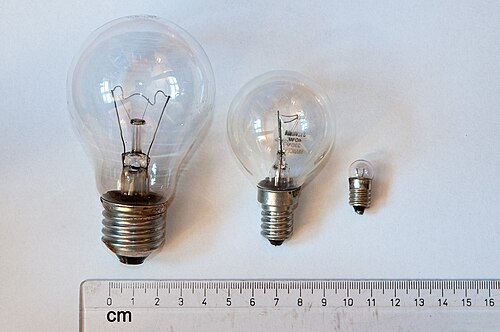
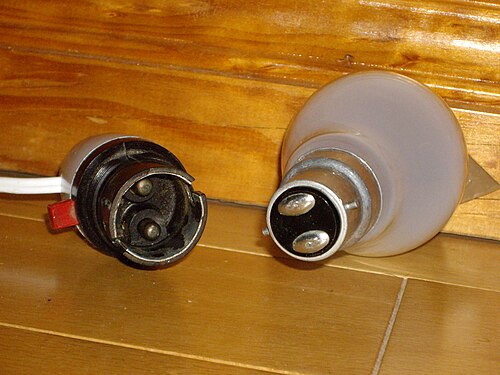
The base code gives the type and size: E means Edison screw and the number is the diameter in millimeters, so E26 is the standard North American base and E27 the European one. B is bayonet, G and GU are two-pin bases, and the number after them is the pin spacing.


| Base | Type | Size | Region or voltage | Typical lamps |
|---|---|---|---|---|
| E26 (medium) | Edison screw | 26 mm | North America, 120 V | A19, BR30, PAR38 |
| E27 | Edison screw | 27 mm | Europe and most of the world, 230 V | A60, globes, reflectors |
| E12 (candelabra) | Edison screw | 12 mm | North America | Candle bulbs, night lights |
| E14 (small Edison) | Edison screw | 14 mm | Europe | Candle, golf-ball and appliance lamps |
| E17 (intermediate) | Edison screw | 17 mm | North America | Appliance and ceiling-fan lamps |
| E39 / E40 (mogul) | Edison screw | 39–40 mm | Worldwide | Streetlights, high-bays, corn lamps |
| B22d | Bayonet, two contacts | 22 mm | UK, Ireland, Australia, India | Household bulbs |
| B15d | Bayonet, two contacts | 15 mm | UK and Europe | Small decorative and appliance lamps |
| GU10 | Twist-lock, two pins | 10 mm pin spacing | Mains voltage | Spotlights |
| GU5.3 | Bi-pin | 5.33 mm pin spacing | 12 V | MR16 spotlights |
| G9 | Looped bi-pin | 9 mm pin spacing | Mains voltage | Capsule lamps in small fixtures |
| G4 / GY6.35 | Bi-pin | 4 or 6.35 mm pin spacing | 12 V | Capsule lamps in cabinet and landscape lights |
| GU24 | Twist-lock, two pins | 24 mm pin spacing | North America, 120 V | Energy-code fixtures that cannot take incandescent bulbs |
| G13 | Bi-pin | 13 mm pin spacing | Worldwide | T8 and T12 tubes |
| G5 | Bi-pin | 5 mm pin spacing | Worldwide | T5 tubes |
| GX53 | Recessed disc with pins | 53 mm pin spacing | Mains voltage | Low-profile downlights |
| R7s | Double-ended | 78 or 118 mm long | Mains voltage | Floodlights, uplighters |
Suffix letters add detail: d means two contacts and s a single contact, and a U in GU or a Y or X in GY and GX marks a variant of the pin design. Bases are standardized internationally in IEC 60061 and in North America in ANSI C81.61. Never force a lamp into a different socket: E26 and E27 bases interchange mechanically, but a lamp must also suit the local mains voltage.
Choosing by lumens, not watts
Choose by lumens, not watts. A 40 W incandescent equals about 450 lumens, 60 W about 800, 75 W about 1,100 and 100 W about 1,600. LED versions use roughly 5, 8–9, 11 and 14–16 watts. For reflector lamps, compare center-beam candlepower and beam angle as well.
These equivalents come from the U.S. Federal Trade Commission's lighting label rules, and the lumen equivalents table covers halogen and CFL too. Reflector lamps are harder to compare by lumens alone, because a narrow beam concentrates the same light into a brighter spot; the center-beam candlepower (CBCP), in candelas, describes that intensity.
Reflector lamps and beam angles
BR lamps have a soft-edged wide beam for general downlighting, PAR lamps a tighter, more controlled beam for accent and outdoor flood lighting, and MR16 and GU10 lamps a compact spot for display. Packaging codes such as SP, NFL, FL and WFL indicate spot, narrow flood, flood and wide flood.
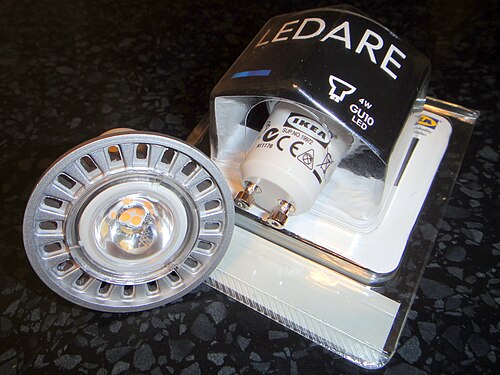

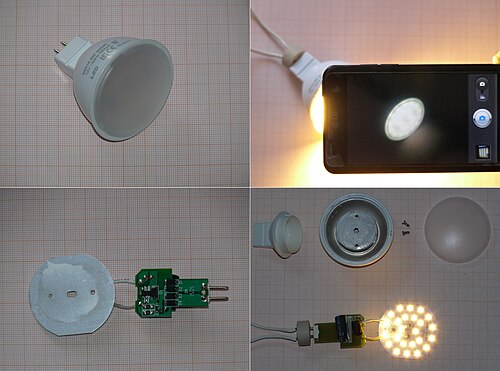

Names vary between manufacturers, but spots are roughly 10–25°, floods roughly 36–60° and wide floods wider still; the beam angles table shows typical uses and spacing. An MR16 runs on 12 V from a transformer, which must be LED-compatible; many flicker problems with MR16 retrofits come from old magnetic or electronic transformers with too high a minimum load. GU10 lamps run directly on mains voltage, which makes them simpler to retrofit.
LED tubes: Type A, B, C and A/B
LED tubes replace fluorescent T8 and T5 lamps in four ways. Type A plugs into the existing ballast, Type B bypasses the ballast and runs on mains wired to the sockets, Type C uses a separate external driver, and hybrid Type A/B works either way. Type B avoids ballast losses but requires rewiring.
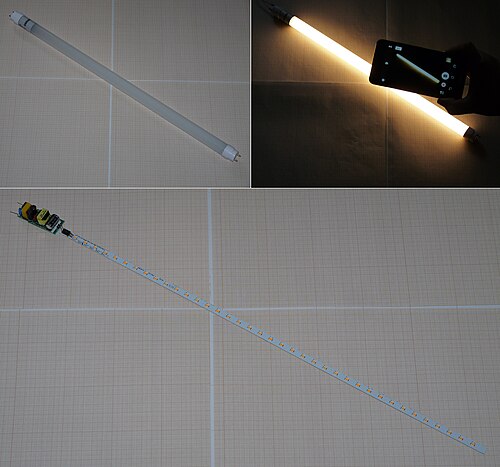

- Type A (plug and play): works with a compatible electronic ballast. It is the easiest swap, but the ballast still uses power and can fail.
- Type B (ballast bypass): mains power is wired straight to the sockets. Single-ended and double-ended versions need different wiring, and the fixture should be relabeled; a mismatch can be a shock hazard.
- Type C (remote driver): a separate LED driver powers the tubes at low voltage. It is the most efficient and dimmable option, at the highest cost.
- Type A/B (hybrid): runs on a ballast now and can be rewired later when the ballast fails.
In North America, Type A tubes are certified under UL 1993 and Type B and C retrofits under UL 1598C.
What to check before you buy
Before buying, check four things: the base, whether the lamp physically fits the fixture, enclosed-fixture and damp or wet ratings, and dimmer compatibility. Enclosed glass shades trap heat that shortens LED life, so use lamps rated for enclosed fixtures, and on dimmers choose lamps marked dimmable from the maker's compatibility list.
- Fit: LED lamps can be longer or heavier than the bulbs they replace because of the driver and heat sink; measure shades, harps and recessed cans.
- Location rating: use damp-rated lamps in bathrooms and covered porches, and wet-rated or IP65 products where water can reach them (see IP ratings).
- Color: pick one color temperature per room and CRI 90 or more for living spaces (see the CRI and CCT guide).
- Dimming: non-dimmable lamps can flicker, buzz or fail on a dimmer (see LED drivers and flicker).
Frequently asked questions
What does A19 mean?
The standard household bulb shape (A) with a maximum diameter of 19 eighths of an inch, about 2⅜ inches or 60 mm. In Europe the same shape is called A60.
Are E26 and E27 interchangeable?
Mechanically, yes: the threads differ by only 1 mm and the bulbs fit each other's sockets. But check the voltage: a 120 V lamp can fail on 230 V mains.
What is the difference between BR30 and PAR30?
Both are 3¾ inches across, but a BR30 has a soft, wide beam for general downlighting, while a PAR30 has a sharper, more controlled beam for accent and track lighting.
What is the difference between MR16 and GU10?
They look similar, but MR16 lamps use GU5.3 pins and run on 12 V from a transformer, while GU10 lamps use twist-lock pins and run directly on mains voltage.
How many lumens replace a 60-watt bulb?
About 800 lumens, which an LED typically delivers with 8–9 watts.
Do I need to remove the ballast for LED tubes?
Only for Type B tubes. Type A tubes work with a compatible ballast, Type C use their own driver, and hybrid Type A/B tubes work either way.
Sources and further reading
- IEC 60061-1, Lamp caps and holders together with gauges for the control of interchangeability and safety: Lamp caps, International Electrotechnical Commission (IEC).
- ANSI C79.1, Nomenclature for Glass Bulbs Intended for Use with Electric Lamps; ANSI C81.61, Electrical Lamp Bases: Specifications for Bases (Caps) for Electric Lamps.
- ANSI C78.20 (A, G, PS and similar shapes) and ANSI C78.21 (PAR and R shapes), American National Standards for electric lamps.
- U.S. Federal Trade Commission, Energy Labeling Rule, 16 CFR Part 305 (Lighting Facts label and lumen equivalents).
- UL 1993, Self-Ballasted Lamps and Lamp Adapters; UL 1598C, Light-Emitting Diode (LED) Retrofit Luminaire Conversion Kits.
- U.S. DOE, "Lighting Choices to Save You Money," Energy Saver.
- NEMA SSL 7A-2015, Phase-Cut Dimming for Solid State Lighting: Basic Compatibility.
Image credits
- Assorted LED lamps: NIST, public domain. Edison screw bases: Medvedev, CC0. Bayonet cap and holder: Jnestorius, CC BY-SA 3.0.
- GU10 spotlight: Matt Kieffer, CC BY-SA 2.0. MR16 lamp and LED tube: Dmitry G, CC BY-SA 3.0. All via Wikimedia Commons.