LED headlights and conversions
Factory LED vs halogen, beam pattern and glare, HID vs LED, legality, cooling and color
An LED headlight is a vehicle headlamp whose light comes from light-emitting diodes instead of a halogen filament or an HID arc. It is legal and predictable when the whole lamp was designed and certified around its LEDs. It is a gamble when an LED bulb is pushed into a housing designed for a halogen filament.
A headlamp is not just a light source. It is a lens, a reflector or projector, a cutoff and a light source all tuned together, so changing only the bulb changes the beam. This guide explains how factory LED headlamps differ from halogen, why some LED bulbs cause glare, how HID, LED and halogen compare, what FMVSS 108 says about plug-in bulbs, and what cooling and color to expect. Bulb codes, sockets and turn-signal errors have their own pages: start with the guide map or the car bulb guides.
How do factory LED headlights differ from halogen ones?
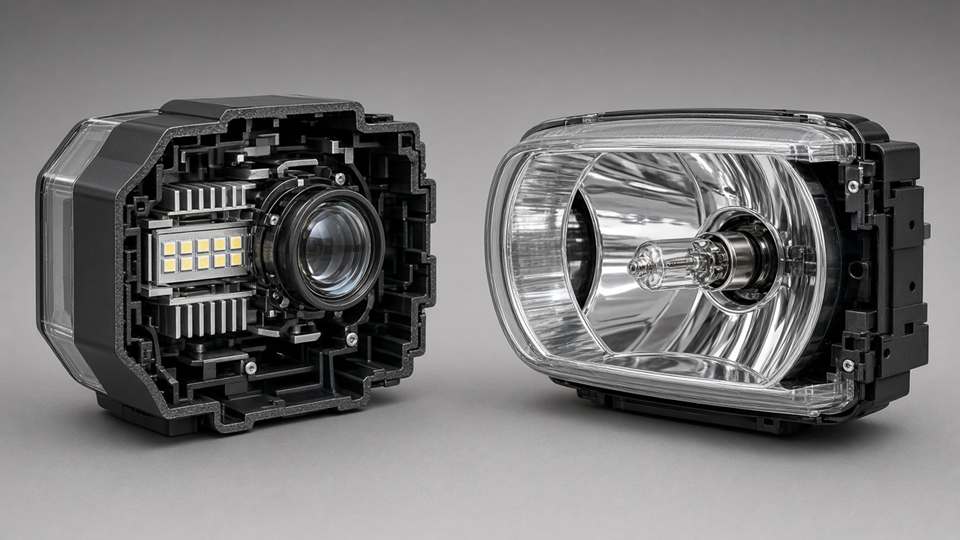
A factory LED headlamp is designed around its LEDs: chips, lenses or reflectors, heat sink and driver are tested together as one certified unit. A halogen headlamp is designed around a glowing filament in a replaceable bulb. That difference in design, more than raw lumens, explains why LED conversions behave so differently.
In a halogen lamp the filament is a short coil of tungsten wire that glows in every direction. The reflector or lens is shaped around that one small, precisely placed source, and the bulb's base locks it into position. In a factory LED lamp the chips sit on a board that is fixed in the housing, usually facing a reflector or a small lens, and the maker has measured the resulting pattern on a screen, adjusted it and certified it. The driver, heat sink and aiming screws are part of the same design, so every lamp leaves the factory with the same beam.
Factory LEDs also change how the car lives. They switch on instantly, draw far less current than a 55–65 W halogen pair, and last far longer, often as long as the car. The downside is that they cannot be repaired as bulbs: a failed LED module usually means a new headlamp assembly. LED lenses also stay cool, so snow and ice can cling to them in a way halogen lenses, which warm up, rarely allow.
What are the common problems with halogen reflector headlights?
Most dim halogen headlights are limited by the lens and reflector, not the bulb. Yellowed or hazed polycarbonate can cut light output sharply, an old reflector coating loses shine, and a corroded socket or thin wiring drops voltage. Restoring the lens, fixing the connector and re-aiming often helps more than any bulb swap.
Polycarbonate lenses have a clear coat that fails with UV exposure, first going cloudy and then yellow. Restoring or replacing the lens is the cheapest real improvement on an older car. Check the connector for browned plastic, a sign of resistance heating, and consider a relay harness if the factory wiring drops voltage between the battery and the bulb. Then replace bulbs in pairs, aim the lamps, and only then judge whether you want a different light source.
Why do some LED bulbs cause glare and dark spots?
A headlamp housing focuses light from a filament's exact position. An LED bulb emits from flat chips facing outward, so even a small offset sends light above the cutoff into oncoming eyes while leaving dark patches on the road. Good bulbs copy the filament's position and size, and the lamps must be aimed again.
A halogen filament is a thin source that radiates all around. An LED chip is a flat emitter that radiates mainly from its face, so a bulb that places chips on a board is a very different source in shape. Reflectors and projectors send each ray where the geometry says it should go, and rays from a source that sits a millimetre or two out of place leave at the wrong angle. Light thrown above the cutoff dazzles other drivers, while the road in front can end up with gaps, a dim center or a hot spot. More lumens on the box do not help if the pattern is wrong.
Headlamp researchers, including the University of Michigan Transportation Research Institute, and IIHS test engineers have long stressed that how light is distributed matters more than how much is produced: seeing distance and glare are set by the shape of the beam. A bulb is only as good as the pattern it makes in your specific housing.
What is a cutoff, and how do you check it?
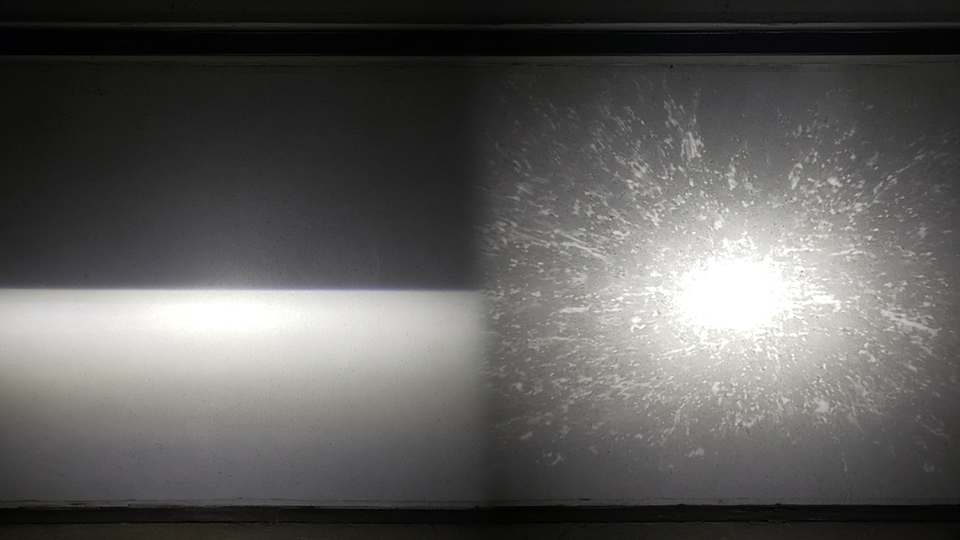
The cutoff is the sharp upper edge of a low beam that keeps light off the eyes of oncoming drivers. In right-hand traffic it is flat on the left and steps up toward the right shoulder. Park square to a wall at night and check that the edge is crisp, with no bright light above it.
Park on level ground about 7.6 m (25 ft) from a wall or garage door, with the tires correctly inflated and the car unloaded. Switch on the low beams and look for a bright, even band with a clear horizontal edge on the oncoming side and a step up on the curb side. Light spilling above that edge, a fuzzy edge, vertical streaks or a dark hole in the middle are the signs of a mismatched source. Compare against the same lamp with a halogen bulb if you can.
Which LED bulb designs come closest to a filament?
The closest designs use thin double-sided or slim-board emitters, with chips placed where the filament sat. Compact CSP chips help, and a rotatable collar lets you aim the chips sideways, usually at 3 and 9 o'clock. Check that the chips are the same size as the halogen filament and that the board does not block the shield.
Look for bulbs that publish a measured beam comparison against the halogen original, give an explicit clocking instruction, and have a collar that can be rotated before locking. Bulbs with thick boards, fans mounted at the front or large lenses over the chips rarely fit a projector well. Even the best-matched design remains a conversion and it is still only legal where local rules say so, as explained in the legality section below.
HID vs LED vs halogen: how do they compare?
Halogen is cheap, instant, warm in color and short-lived at about 1,000 lumens per low beam. HID xenon puts out roughly three times that from a 35 W arc but needs a ballast, warm-up and projector optics. LED matches or beats HID with less power, instant start, and life measured in the tens of thousands of hours.
| Feature | Halogen | HID (xenon) | LED |
|---|---|---|---|
| Light source | Heated tungsten filament in halogen gas | Arc between electrodes in xenon and metal salts | Semiconductor chips with phosphor |
| Rated output per bulb | About 1,000–1,700 lm (H7 about 1,500) | About 3,200 lm (D2S, 35 W) | Varies: good lamps 1,000–3,000+ lm in the beam |
| Power per lamp | 55–65 W | 35 W plus ballast losses | 15–40 W |
| Typical color | About 3,000–3,200 K | About 4,100–4,500 K | 5,000–6,500 K |
| Start-up | Instant | A few seconds to strike and settle | Instant |
| Rated life | 500–1,000 h | 2,000–3,000 h | 10,000–50,000 h, with good cooling |
| Needs special optics | No, works in reflectors | Projector, plus auto-leveling and washers above 2,000 lm in ECE countries | Designed in; retrofit bulbs fit best in projectors |
| Plug-in retrofit in the U.S. | Standard | Not permitted | Not permitted |
HID was the first big jump over halogen, and ECE regulations (R48) require automatic leveling and lens cleaning for sources above 2,000 lm because their light could dazzle if the car pitches. LEDs removed the warm-up, the ballast and the mercury of early HID lamps while using less power, and they now dominate new cars. Note that "lumens per bulb" on aftermarket packaging usually adds up chip ratings, while ECE and SAE numbers measure the bulb. For the maths of lumens, watts and efficacy, see LED efficacy compared.
Projector or reflector: which housing handles LED bulbs better?
A projector headlight focuses light through a lens and a metal cutoff shield, giving a sharp edge that tolerates small source changes. A reflector headlight bounces light off a shaped bowl and depends on the source sitting exactly where the filament was. For LED bulbs, projectors are more forgiving, but both can fail.
| Housing | How it forms the beam | Cutoff | With an LED bulb |
|---|---|---|---|
| Reflector | Light from the filament reflects off a faceted or smooth bowl behind it | Made by the filament shield or the reflector shape; soft | Most sensitive: chip position errors scatter light above the cutoff and leave dark patches |
| Projector | Reflector focuses light through a lens, and a shield blocks the top | Sharp and adjustable by shield design | More forgiving, but the chips must sit at the focus; some bulbs still bloom above the line |
| Factory LED module | Chips, lens or reflector and shield are designed together | Sharp, certified | Not applicable: the lamp is the LED |
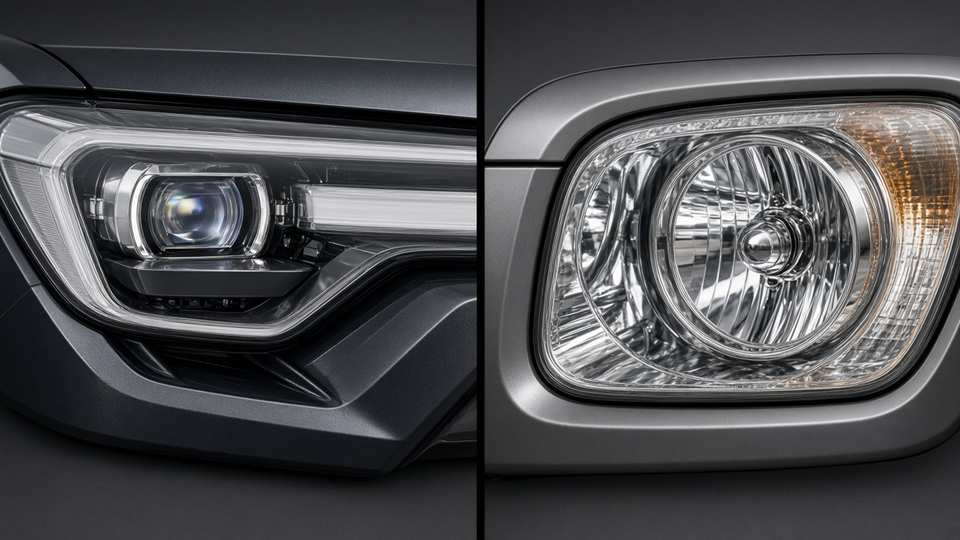
A reflector lamp is the standard housing in older cars and many trucks: an open bowl, usually behind a clear or prismatic lens, with a filament at its focus. A projector looks like a small round lens in a metal cup. If a car came with projectors for HID or LED from the factory, replacement is easier because the shield was designed for it. Check the manual or the markings on the lamp for the legal bulb type. Never swap an HID or LED into a reflector housing that was only certified for halogen: that is where the worst glare complaints begin.
Are plug-in LED headlight bulbs legal?
In the United States, no: NHTSA says FMVSS 108 permits only the replaceable bulbs filed under 49 CFR Part 564, and no LED bulb is filed. In UNECE countries, only approved LED substitutes are legal, in listed vehicles. A complete DOT-compliant LED headlamp assembly is the clear legal route.
These rules decide what a retailer can sell as a headlamp and what an inspection can flag, even though a driver's exposure depends on state or national law. The model-by-bulb details are on the bulb pages: see H11, 9005 and 9006 and H4 and H7. The summary here is enough to understand the logic.
What does FMVSS 108 say about LED bulbs in halogen housings?
FMVSS 108 requires headlamp bulbs to match the specifications filed in 49 CFR Part 564, and NHTSA has said no LED bulb is filed, so none is permitted in a replaceable-bulb headlamp. The federal rule applies to what is sold, and "for off-road use only" labels do not make an on-road conversion lawful.
The standard sets photometric rules for headlamps as a system, measured with the bulb the lamp was approved with. A conversion bulb can make the same housing fail those rules even if both look bright. Enforcement against owners is left mostly to states, so the practical risk depends on where you live, but a conversion that fails inspection or glares at others is still your problem. Check your own state or provincial rules.
What about Europe and other countries?
UNECE countries allow LED substitutes only when they hold approval under UN Regulation 128 or a national certificate, and only in vehicles on the maker's list. Germany's KBA has approved a handful of LED H7 and H4 bulbs, and UN R128 added H11/LED. Most other LED bulbs sold online lack any approval.
Approval is tied to the vehicle because the beam depends on the housing and the bulb together. Approved substitutes often use different connectors, and some require a certificate to be carried in the car. If you are looking at a bulb that says "E-marked" but gives no vehicle list, treat the claim cautiously and read the exact regulation number and vehicle list.
What is the legal way to upgrade to LED headlights?
Fit a complete LED headlamp assembly, ideally DOT or SAE marked in the U.S. or E-marked in Europe, and aim it after installation. Some cars have factory LED housings you can swap for, and many round sealed-beam sizes have complete LED replacements. Replacing a hazed lens or a worn halogen with a quality bulb is legal too.
A complete lamp has its own emitters, optics, heat sink and driver, so its beam is designed around the LEDs, as in the complete LED headlamps and tail lights example. That is different from a bulb that merely fits a socket. Check the markings on the lens, keep the paperwork, and fit it with a harness that suits the lamp.
Do LED headlight bulbs need fans or heat sinks?
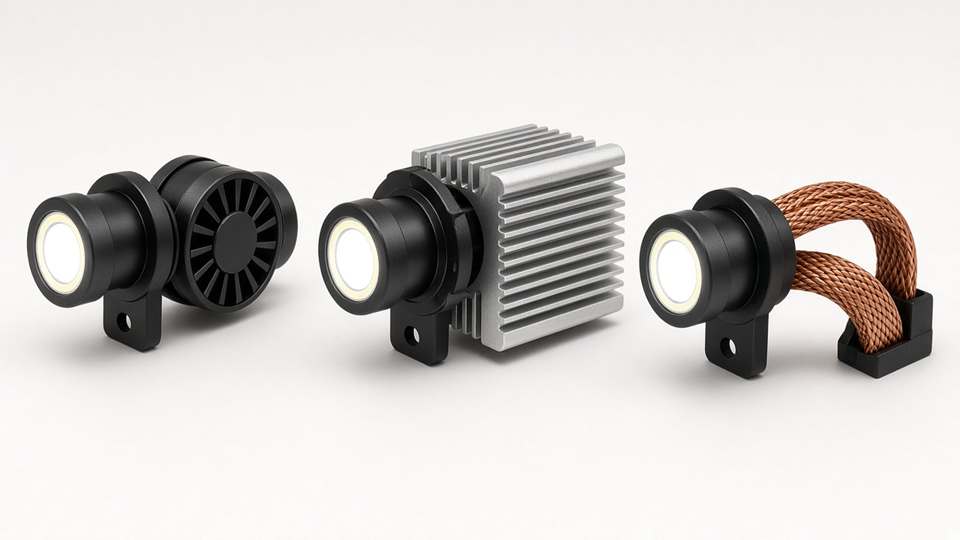
Yes. A headlight LED dissipates 15–30 W of heat in a very small space, and chips lose light and life as they heat up. Cooling is done by an aluminum heat sink, flexible braided copper straps or a small fan. All three work, but each needs room behind the lamp and a dust cap that still fits.
Heat is the main limit of LED headlights, and it shows in cheap bulbs as dimming after ten minutes (thermal foldback) and early failure. Fanned bulbs move the most heat in the least space, but a fan can clog, seize or whine, and its bearing is a wear item. Fanless designs use fins or a braided copper strap as a heat path and are quiet, but they are longer and must sit in free air. The COB, SMD and CSP heat guide explains why heat sinks matter, and LED lifespan shows how junction temperature drives life.
What should you check before buying: clearance, dust cap and driver?
Measure the free space behind the headlamp, because most LED bulbs are much longer than the halogen they replace. Check that the dust cap can still seal, that the driver box has a place to sit, and that the connector, harness and bulb-out sensing suit your car.
Moisture is a second hidden risk: a loose dust cap lets damp air into the lamp, and the condensation stays. Fit the cap fully, route the driver and wires away from sharp metal, and leave a loop for water to drip off. If the dash then reports a bulb out, or the turn signals flash fast, see the CANbus-ready bulbs and hyperflash fixes pages.
What color temperature should LED headlights be?
Choose 5500–6500 K white, which looks like daylight and gives good contrast. Halogen is about 3000–3200 K and OEM HID about 4100–4500 K. Blue-tinted 8000 K bulbs cut usable light, glare more in rain and snow, and may fail the white-color limits headlamps must meet.
Kelvin describes color, not brightness: a 6,500 K bulb is not automatically brighter than a 5,500 K one, and the bluer one has less red and yellow, so wet roads and fog look harsher. Headlamp light must stay within a defined white color region (SAE J578 in the U.S., equivalent ECE limits); beyond about 6,500 K it drifts into blue and then purple. For the physics, see color temperature (CCT). For amber or selective-yellow auxiliary lamps in dust and fog, see the amber vs white off-road guide.
What are matrix and adaptive driving beam headlights?
Matrix or adaptive driving beam headlights split the high beam into dozens or hundreds of LED segments, and a camera switches off only the segments that would dazzle other drivers. Audi introduced them on the 2013 A8. NHTSA's 2022 final rule allowed ADB in the U.S., but only as factory systems, not retrofits.
Matrix lamps need a camera, control software, an LED array and optics that all agree with each other, so they cannot be added to an older car as bulbs. Digital headlights with over a million pixels, built on DMD or micro-LED arrays, can project lane markings and symbols onto the road. See the LED and matrix headlights overview for the history and photos.
How do you install and aim LED headlights?
Install the bulb or lamp, lock it in with chips at the maker's stated angle, seal the dust cap, and then aim the lamps. Park level 7.6 m (25 ft) from a wall, set the cutoff just below the lamp center height or to the factory mark, and check from outside for glare before driving.
- Prepare. Disconnect the battery if the maker says so, remove the old bulb by its base and never touch the glass of a halogen replacement with bare fingers.
- Fit and clock. Seat the LED bulb or lamp, rotate the collar as instructed so the chips face the right way, and lock it before connecting the driver.
- Seal. Refit the dust cap or the new one, route cables with a drip loop and keep the driver clear of hot parts.
- Aim. Use the adjusters on each lamp, with the car unloaded and tires correctly inflated, to place the cutoff where the factory mark or manual says.
- Test. Have a friend stand 30 m ahead at head height, then drive past at night to see how oncoming drivers see the beam.
Which car bulb guide covers which light?
Use this page for how headlights work and what is legal, and the bulb guides for sockets and codes. H11, 9005, 9006, H4 and H7 cover headlight and fog bulbs; 1156, 1157, 3157, 7443, 194 and 168 cover signals and interior lights; the CANbus guide covers warnings and fast flashing.
Frequently asked questions
Are LED headlight bulbs street legal?
In the U.S., plug-in LED bulbs in halogen housings are not permitted under FMVSS 108. In UNECE countries only approved LED substitutes for listed vehicles are legal. Complete LED headlamps certified as units are the legal route.
Why do my LED headlights have glare or dark patches?
The LED chips are not where the halogen filament was, so the housing sends light in the wrong directions. Rotate the bulb to the maker's clocking, aim the lamps again, or use a complete LED headlamp.
Are LED headlights brighter than HID?
Good LED lamps match or beat HID in the beam with less power and no warm-up. Cheap bulbs often do not, because box lumens count chip ratings, not light on the road.
Can I put LED bulbs in reflector headlights?
They physically fit, but reflectors are the least forgiving housing and the conversion is not approved in the U.S. If you try it, check the cutoff on a wall and expect to aim again.
Do LED headlight bulbs need a fan?
They need a cooling path of some kind: a fan, a finned heat sink or braided copper straps. Fanless bulbs are quieter and have no bearing to fail, but they are longer and need free space behind the lamp.
What color temperature is best for headlights?
About 5,500–6,500 K white. Halogen is warmer at about 3,000–3,200 K, and blue-tinted 8,000 K bulbs lose useful light in rain, fog and snow.
Do LED headlights need a CANbus decoder?
Sometimes. Cars that monitor bulb current can show a bulb-out warning or flash fast when a lower-power LED is fitted. See the CANbus guide for the fixes that work without hiding a real fault.
How can I improve dim halogen headlights without LEDs?
Restore or replace hazed lenses, clean the reflector surfaces, check the connectors and add a relay harness if the wiring drops voltage, then fit fresh bulbs in pairs and aim the lamps.
Sources and further reading
- U.S. FMVSS No. 108, Lamps, reflective devices, and associated equipment (49 CFR 571.108), and 49 CFR Part 564, Replaceable light source information.
- NHTSA interpretation letters on LED replacement headlamp bulbs and on adaptive driving beam headlamps; NHTSA final rule permitting ADB (2022).
- UN Regulations 48, 112, 128 and 149 (installation, headlamps, LED light sources and road illumination devices), and the Kraftfahrt-Bundesamt (KBA) approval lists for LED retrofit bulbs.
- SAE J578, Color specification; SAE J1383, Performance requirements for motor vehicle headlamps.
- Insurance Institute for Highway Safety (IIHS), headlight evaluation protocol and ratings.
- University of Michigan Transportation Research Institute (UMTRI), studies on headlamp light distribution and glare (M. Sivak, M. J. Flannagan and colleagues).
Image credits
- Infobox headlamp photo: GENSSI, genssi.com, used with permission (brand under the same ownership as LEDlights.org).
- Factory LED vs halogen cutaway, beam-pattern wall test, projector vs reflector housing, and cooling styles: AI-generated illustrations for LEDlights.org.