Dusk-to-dawn photocells
How light sensors switch outdoor lights, where to put them, and why they misbehave
A photocell, or photocontrol, is a light sensor with a built-in switch that turns outdoor lights on at dusk and off at dawn. Electronic streetlight controls switch on at about 1.5 footcandles (16 lux) and off at about 1.5 times that, and wait a few seconds before switching off, so headlights and lightning do not fool them.
Photocells are the oldest automatic light control and still the most common: every streetlight, most barn and security lights, and many porch lights have one. They are simple, but they misbehave in predictable ways, nearly always because of what they can see. This guide explains the switching levels, the types, which way to point them, LED loads, timers and the common faults.
How a dusk-to-dawn sensor works
A light sensor measures daylight, and a switch connects the lamp when it falls below a set level. Electronic streetlight controls switch on at about 1.5 footcandles and off at about 1.5 times that, a gap that stops them chattering at dusk, and wait a few seconds before switching off, so headlights and lightning are ignored.
A footcandle is one lumen per square foot, or 10.76 lux (see lumens, lux and footcandles), so 1.5 fc is about 16 lux, a level reached well into dusk. TE Connectivity's LUMAWISE ALR 8000 is typical of modern controls: it turns on at 1.5 fc, the ANSI standard setting (1.0 to 2.6 fc to order), turns off at 1.5 times that level, switches on instantly and waits 2–5 seconds before switching off. Acuity's generic specification for its DTL controls sets the same values, with a tolerance of ±0.3 fc.
Older controls are thermal. Their cadmium sulfide photoresistor, whose resistance falls in light, passes current through a small heater on a bimetal strip, as in the photo above: in daylight the warm strip holds the contacts open, and at dusk it cools and lets them close. Thermal controls are cheap, slow and imprecise; Intermatic's and TORK's switch on anywhere from 1 to 5 fc and off at 3 to 15 fc, with delays of 30 seconds to 2 minutes. Electronic controls use a silicon phototransistor, which does not drift with age. Bare silicon is most sensitive in the near infrared, around 950 nm, so good controls filter it to respond more like the eye.
Most streetlight controls fail on: their relay contacts are normally closed, so a dead control leaves the lamp burning day and night rather than leaving the street dark. Fail-off versions, with normally open contacts, exist for places where daytime burning matters more than a dark lamp.
Twist-lock, button and built-in photocells
Twist-lock photocontrols plug into a standard three-prong receptacle on streetlights and area lights and can be replaced from a bucket truck in seconds. Button photocells mount through a small hole in a wall pack, post lantern or box cover. Swivel and wire-in types mount on boxes, and many porch and security lights have a sensor built in.
| Type | Where used | Fit | Notes |
|---|---|---|---|
| Twist-lock, 3-pin | Streetlights, area and barn lights | ANSI C136.10 locking receptacle | Push in and turn; the dome color often shows the voltage and fail mode |
| Twist-lock, 5- or 7-pin | LED streetlights, networked city lighting | ANSI C136.41 receptacle | Extra contacts carry 0–10 V dimming or sensor signals |
| Button | Post lanterns, wall packs, walkway lights | Threaded stem through a small hole | Cheapest; thermal or electronic |
| Stem or swivel | Floodlights, eaves, junction boxes | Threaded stem on a box or fixture | A swivel can be aimed north whichever way the light faces |
| Built-in | Porch lanterns, dusk-to-dawn bulbs, security lights | Part of the light | Works only if the light's own beam cannot reach the sensor |
Which way should a photocell face?
Face the sensor's window north (south in the Southern Hemisphere), so it reads open sky rather than direct sun. Keep it out of the beam of the light it controls and away from porch lights, streetlights and reflective walls. A sensor that sees artificial light will switch the lamp off, cycle on and off, or never turn on.
Installation instructions from TORK, Leviton, WattStopper and Eaton agree on north. Acuity's orientation guide explains why: a sensor facing east sees the darker eastern sky in the evening and the dawn glow in the morning, so it switches on early and off early; one facing west switches late at both ends of the night; facing north, away from the sun's path, gives the most consistent result in the Northern Hemisphere. Eaton warns that a sensor near other lights "might cycle on and off or not turn on".
To check a new installation in daylight, cover the window completely with black tape or an opaque cap. The light should come on, at once with an electronic control or after a minute or two with a thermal one, and go off again after its delay when uncovered. A control is normally on when first installed and turns off after a short delay in daylight, as TORK's instructions note.
Photocells and LED loads
An LED driver draws a surge of current, often many times its running current, for a split second when it switches on. Several drivers on one photocell add up and can weld the relay contacts shut, leaving the lights on permanently. Choose photocontrols with an LED or electronic-ballast rating covering the whole load.
Ratings show the gap. TE's ALR 8000 is rated for 1,000 W of incandescent lamps but 5 A of electronic loads such as LED drivers, and TORK's 3000 button control for 2,000 W of incandescent lamps but only 600 VA of LED. Intermatic notes that LED inrush can reach 100 times the running current, and no longer recommends its thermal controls for LED fixtures because the inrush shortens their 3–5 year design life. Controls made for LEDs soften the surge: TORK's Z-series and Spitzer's ELL close their contacts as the mains voltage crosses zero, when inrush is smallest, and Acuity's DTL controls use a TRIAC to take the surge off the relay. The LED driver guide explains where inrush comes from.
Photocell or astronomical timer?
A photocell responds to actual darkness, including storms, and needs no setting; an astronomical timer calculates sunset and sunrise from the date and location, needs no view of the sky, and can switch off at a set time such as midnight. A plain timer must be reset through the year, because night length changes by hours.
| City | Latitude | June 21 | December 21 | Difference |
|---|---|---|---|---|
| Atlanta | 33.7° N | 9.6 h | 14.1 h | 4.5 h |
| Chicago | 41.9° N | 8.8 h | 14.9 h | 6.1 h |
| Seattle | 47.6° N | 8.0 h | 15.6 h | 7.6 h |
| London | 51.5° N | 7.4 h | 16.2 h | 8.8 h |
| Berlin | 52.5° N | 7.2 h | 16.4 h | 9.2 h |
A timer set for June would leave Chicago dark for six hours of a December night. Photocells and timers also combine: TORK's phototimers switch on at dusk like a photocell, off at a set time such as midnight, and optionally on again before dawn, which saves energy on lights nobody needs at 3 a.m. For outdoor lights, that also means less light in the sky through the darkest hours.
Troubleshooting: cycling, staying on, never turning on
Most photocell faults come down to what the sensor sees. A light that cycles on and off at night is seeing its own light. One that never comes on is seeing a porch light, streetlight or reflection. One that stays on in daylight is usually a failed sensor, since most fail on, or a dirty or covered window.

| Symptom | Likely cause | Fix |
|---|---|---|
| Cycles on and off after dark | The sensor sees its own lamp, directly or reflected off a wall, window or snow | Move or shield the sensor so it cannot see the beam |
| Never turns on | Another light shines on the sensor; failed control; no power | Shield or move it; cover-test it; check the supply |
| On during the day | Failed control (most fail on); window blocked by dirt, snow or cobwebs; just installed | Clean the window; wait out the delay after installing; replace the control |
| Switches too early or too late | Facing east or west; shaded by eaves or trees; an old thermal control | Face it north into open sky; replace thermal controls with electronic ones |
| LED lights flicker at dusk or dawn | A chattering relay in a worn or unsuitable control | Fit an electronic control rated for LED loads |
Frequently asked questions
Why does my dusk-to-dawn light stay on during the day?
Usually the control has failed: most are made to fail on, so a dead one leaves the light burning. A window covered by dirt, snow or a cobweb, or a sensor mounted in deep shade, does the same. A newly installed control also starts on and switches off after its delay.
How do I test a photocell?
In daylight, cover its window completely with black tape or an opaque cap. An electronic control should switch the light on at once, a thermal one within a minute or two; uncover it and the light should go off after the delay. If nothing changes, the control or its wiring has failed.
Can I use a photocell with LED lights?
Yes, if it is rated for LED loads at the total wattage. LED drivers draw a large inrush current that can weld the contacts of controls built for incandescent lamps; zero-cross and TRIAC-assisted electronic controls are designed for it.
Which way should a photocell face?
North in the Northern Hemisphere and south in the Southern, toward open sky and away from the light it controls and from other lights. Facing east makes it switch early, and facing west makes it switch late.
What does fail-on mean?
If the control fails, the light stays on. Streetlights use fail-on controls so a fault leaves the street lit, at the cost of a lamp burning in daylight until someone reports it. Fail-off versions exist where daytime burning matters more.
Sources and further reading
- ANSI C136.10, Locking-Type Photocontrol Devices and Mating Receptacles: Physical and Electrical Interchangeability and Testing; ANSI C136.41, Dimming Control Between an External Locking Type Photocontrol and Ballast or Driver.
- TE Connectivity, LUMAWISE ALR 8000 Series Photocontrol: product flyer and customer drawing.
- Acuity Brands, Dark to Light (DTL) Outdoor Controls product reference guide, including the photocontrol orientation guidance, and the DTL multi-volt photocontrol generic specification.
- NSi Industries, TORK Photocontrols and Accessories catalog (thermal, zero-cross and phototimer controls) and TORK 3000 data sheet.
- Intermatic, K4000 and K4100 thermal photocontrol data sheets, and Thermal and Electronic Photocontrols brochure.
- Leviton, WattStopper and Eaton photocontrol installation instructions.
- Spitzer, ELL electronic photocontrol for LED loads.
- Night lengths: calculated by LEDlights.org for the solstices (solar declination ±23.44°, sun's center 0.833° below the horizon at sunrise and sunset).
Image credits
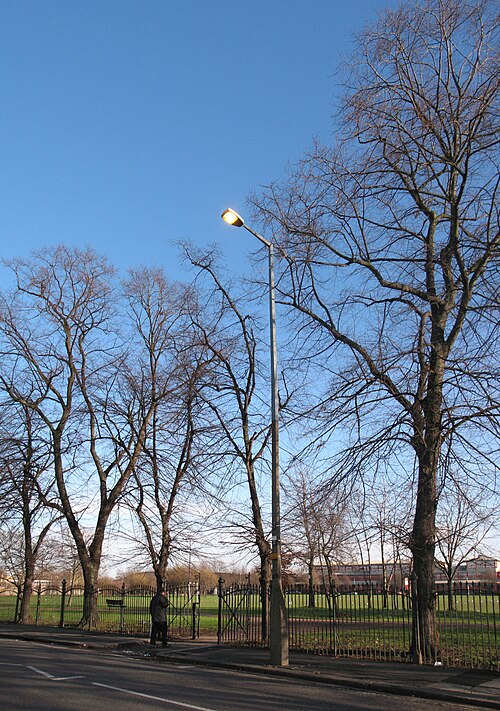
- Photocontrol interior: Atlant, CC BY-SA 3.0. Streetlight in daylight: Alan Stanton, CC BY-SA 2.0. Both via Wikimedia Commons.