LED grow lights
PAR, PPFD and DLI, efficacy, spectrum, hanging height and how to compare fixtures
The daily light integral (DLI) is the total number of photosynthetically active photons that land on one square meter of plants in a day, in moles per square meter per day. It is the plant equivalent of a daily dose, and it is calculated as PPFD × hours of light × 0.0036.
Plants run on photons, not lumens, so grow lights are specified in different units from home lighting. This guide explains PAR, PPF, PPFD and DLI, how to turn a crop's light target into a fixture and a schedule, what photon efficacy means, why modern fixtures use white light plus red, how high to hang a light, how to compare products beyond marketing, and the heat and electrical basics. The short version is on the applications page.
PAR, PPF and PPFD: measuring light for plants
Plants respond to photons, not lumens. PAR is the 400–700 nm band they use. PPF, in µmol/s, is a fixture's total PAR output; PPFD, in µmol/m²/s, is what lands on one square meter of canopy. PPF describes the lamp, PPFD describes a place, and the same fixture gives very different PPFD at different heights.
Lumens are weighted for the human eye, which sees green best and barely sees deep red, so they misjudge a grow light. ANSI/ASABE S640 defines the plant quantities, and the U.S. Department of Energy uses the same definitions: PPF is photons per second in the 400–700 nm band, and efficacy divides it by electrical power. For scale, bright summer sun delivers roughly 2,000 µmol/m²/s at noon, while a leafy-green crop is often grown at 200–400.
PPF and PPFD are linked by area and by how much light misses the plants. A fixture with a PPF of 1,000 µmol/s over a 1.2 × 1.2 m (1.44 m²) bed could in theory average 694 µmol/m²/s; if 85% of its photons land on the bed, the average is about 590. Walls, reflective surfaces and fixture spacing change that capture. McCree's 1972 measurements on 22 crop species show why spectrum still matters per photon: photosynthesis per photon is highest in the orange-red and about a quarter lower in blue, with green also contributing.
Daily light integral (DLI): the formula
DLI is the total PAR photons a canopy receives in a day, in mol/m²/day. Calculate it as PPFD × hours of light × 0.0036, because 3,600 seconds per hour divided by 1,000,000 converts micromoles to moles. For example, 250 µmol/m²/s for 16 hours gives 14.4 mol/m²/day, a typical lettuce target.
Rearranged, PPFD = DLI ÷ (hours × 0.0036). A 14 mol/m²/day target over 16 hours needs about 243 µmol/m²/s; over 12 hours it needs about 324. A shorter photoperiod therefore needs a brighter light for the same dose, and for many crops the dose matters more than how it is split. The exceptions are photoperiod-sensitive plants, such as short-day flowering crops, which need a set night length whatever the DLI.
For comparison, natural DLI runs from under 5 mol/m²/day on a dark winter day to roughly 50–60 on a clear summer day at mid-latitudes (Faust and Logan, 2018). That range is why a grow light supplements winter greenhouse light and replaces sunlight in a basement.
Typical DLI targets: lettuce, herbs and cannabis
Conservative published and extension targets are about 12–17 mol/m²/day for lettuce and leafy greens, 15–25 for basil and other herbs, about 20–40 for vegetative cannabis and 30–45 or more in flower. Treat them as starting points: cultivar, CO₂, temperature, nutrition and growth stage all move the optimum for your crop.
| Crop / stage | DLI (mol/m²/day) | Example that delivers it |
|---|---|---|
| Seedlings, clones, microgreens | 6–15 | 175 µmol/m²/s × 16 h ≈ 10 |
| Lettuce and leafy greens | 12–17 | 250 µmol/m²/s × 16 h ≈ 14 |
| Herbs (basil) | 15–25 | 350 µmol/m²/s × 16 h ≈ 20 |
| Tomatoes, peppers, cucumbers | 20–30 | 500 µmol/m²/s × 14 h ≈ 25 |
| Cannabis, vegetative | 20–40 | 430 µmol/m²/s × 18 h ≈ 28 |
| Cannabis, flowering | 30–45+ | 830 µmol/m²/s × 12 h ≈ 36 |
These ranges agree with the PPFD and photoperiod table on the applications page. They are not ceilings. In a University of Guelph trial, indoor cannabis yield rose linearly as canopy PPFD increased from 120 to 1,800 µmol/m²/s over a 12-hour flowering photoperiod (about 5 to 78 mol/m²/day), even though leaf-level photosynthesis saturated well below that. More light only pays when temperature, CO₂, water and nutrition keep up, and the extra electricity and cooling have to be worth it. Cannabis is regulated differently in different places, so check local law.
Photon efficacy (PPE): µmol per joule
Photon efficacy, PPE, is PPF divided by electrical watts, in µmol/J. A fixture making 1,420 µmol/s from 480 W delivers about 2.96 µmol/J. Top LED fixtures reach 2.7–3.1 µmol/J, against about 1.7–1.9 for double-ended HPS, so they make roughly half again as many photons per kilowatt-hour.
Because a watt is a joule per second, 1 µmol/J equals 3.6 mol of photons per kilowatt-hour. A 2.9 µmol/J LED therefore makes about 10.4 mol per kWh and a 1.8 µmol/J HPS about 6.5. At $0.15 per kWh that is roughly 1.4 cents against 2.3 cents per mol. Delivering 14.4 mol/m²/day to a lettuce bed costs about 1.4 kWh per square meter of canopy at best, and more once light spills past the plants.
Efficacy has limits. Kusuma, Pattison and Bugbee (2020) calculated that, with current LEDs, practical fixtures top out near 3.4 µmol/J for white plus red and 4.1 µmol/J for blue plus red, and that waterproofing a fixture costs roughly 10%. The U.S. Department of Energy reports products claiming up to 3.2 µmol/J, with the best double-ended HPS specified near 2.1 before ballast losses. Efficacy is also not yield: it counts photons made, not what they do to the crop or how many reach it.
Spectrum: blurple versus white plus 660 nm red
Early LED grow lights used only 660 nm red and 450 nm blue chips, giving a magenta "blurple" glow. Modern fixtures mostly combine full-spectrum white LEDs with extra 660 nm red. That mix is efficient, includes green, and shows the plants in true color, so you can spot pests, deficiencies and disease while you work.
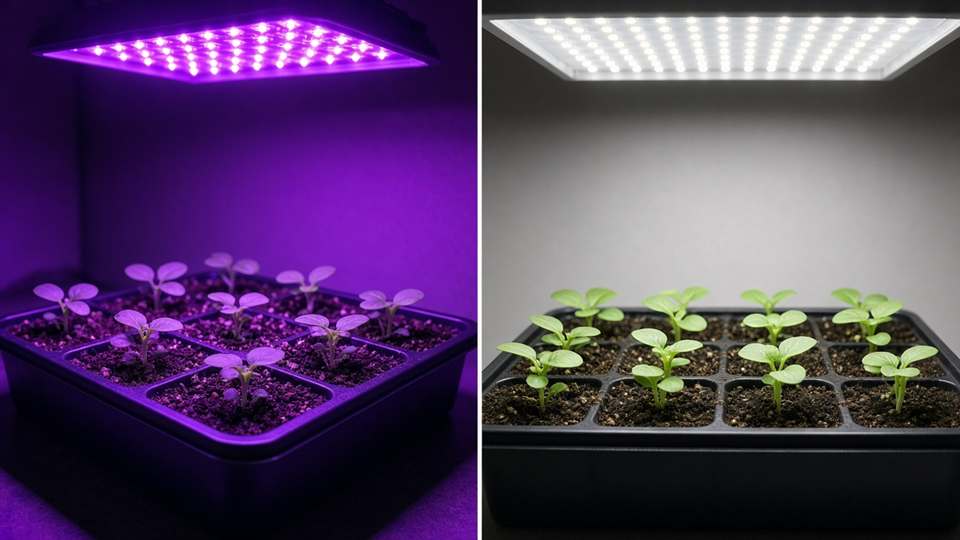
Chlorophyll absorbs best in blue and red, which is why red and blue chips were first. They are efficient photon makers: Kusuma and colleagues give radiant efficiencies of about 93% for blue, 81% for red and 76% for phosphor-converted white LEDs, and they found that the effects of spectrum on photosynthesis are remarkably similar across species. Morphology is another matter: blue fraction and far-red affect stretch and leaf size differently in different crops.
White light has practical advantages. Green penetrates deeper into the canopy and still drives photosynthesis, a CRI of 80 or more makes leaf color readable (see CRI), and people can work comfortably under it. A 3000–4000 K white with extra 660 nm red is the usual choice. Some fixtures add UV-A or UV-B to influence pigments and other compounds; evidence is mixed by crop, and UV can harm eyes, skin and plastics, so treat it as a specialist option.
Far-red 730 nm and the Emerson effect
Far-red near 730 nm lies just outside the 400–700 nm PAR band. Emerson showed in 1957 that far-red plus shorter wavelengths drives photosynthesis faster than either alone. Zhen and Bugbee (2020) found far-red photons about as efficient as PAR photons mixed with white light, and far-red also acts through phytochrome on stretch and flowering.
Because PPF and PPFD ignore wavelengths above 700 nm, a fixture's PPE does not count its far-red output, and some makers quote a separate far-red figure or an "extended" 400–750 nm total. Phytochrome responses are the practical catch: more far-red makes many plants taller with larger leaves, and speeds flowering in some short-day crops. That can help lettuce yield or be unwanted stretch, so use far-red deliberately, ideally on its own channel, and not as a default.
Hanging height and uniformity
PPFD falls as a canopy moves away from a fixture, though not by a clean inverse-square law, because most LED fixtures are wide area sources. Hang each light at the height its maker's PPFD map states, usually 30–45 cm (12–18 in), and judge uniformity by the minimum-to-average ratio, not the peak under the center.
Raising a light spreads its output over a wider footprint: PPFD drops and evens out, and more light lands beyond the canopy. Lowering it concentrates light and raises the risk of a hot spot. The usual fix is several smaller fixtures spread evenly rather than one big one. Where the maker's map gives an average of 600 µmol/m²/s and a minimum of 420 across the bed, the uniformity is 0.70, and closer to 1.0 is better.
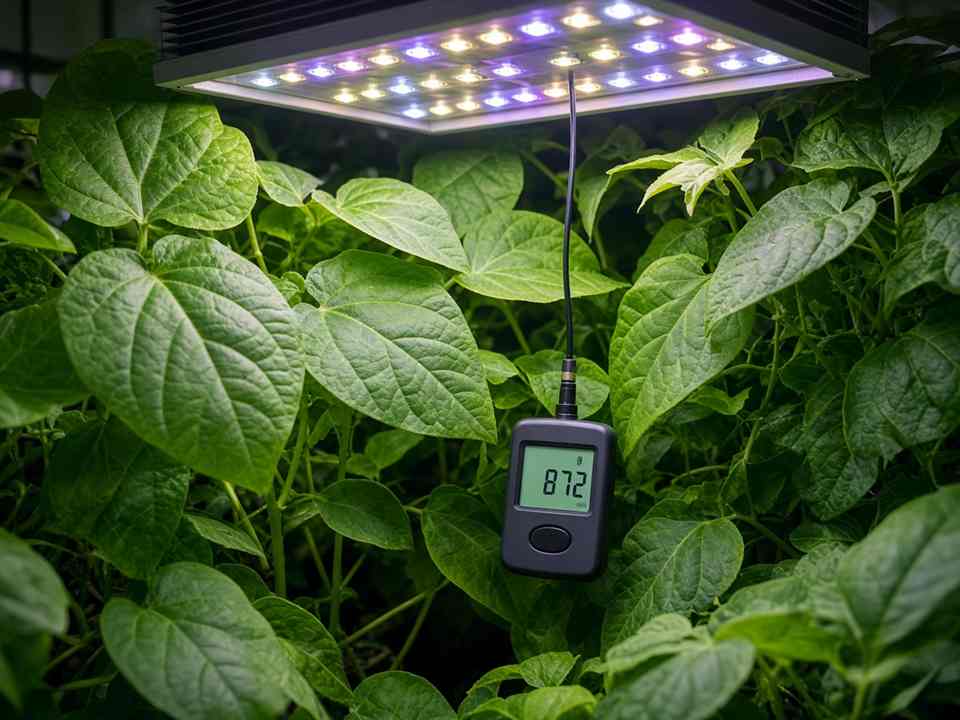
Reflective walls help most in small tents and rooms: flat white paint reflects roughly 80–90% of visible light, and bare dark walls far less. Measure rather than guess. Take readings on a grid at canopy height, for example 3 × 3 or 5 × 5 points, and multiply the average by your hours to check the DLI. As plants grow toward the light, the effective height shrinks, so raise the fixture or dim it.
Comparing fixtures beyond brand marketing
Compare fixtures by measured numbers, not watts or "equivalent" labels: PPF in µmol/s, efficacy in µmol/J, and a PPFD map at a stated height showing average and minimum. Check that wall-plug watts, test source and warranty are real. A full-spectrum quantum meter confirms the claims in your own growing space.
| Check | Why it matters |
|---|---|
| True wall power | Many "1000 W equivalent" lights draw about 100 W; a plug-in power meter shows the real figure |
| PPF and PPE with a source | An independent lab report, or a listing such as the DesignLights Consortium horticultural list, beats a catalog claim |
| PPFD map | Needs a stated height, grid and area; look at average and minimum, not the peak |
| Spectrum split | Shares of blue, green, red and far-red photons let you compare like with like |
| Cost per mol | Price divided by lifetime mol, plus electricity, matters more than price per watt |
| Dimming and control | Lets you trim DLI as plants grow and run a separate far-red channel |
| Lifetime and warranty | Look for an L90 or L70 figure and a warranty that covers the driver (see LED lifespan) |
A 480 W fixture rated at 1,420 µmol/s is 2.96 µmol/J. To size a light for a target, divide the PPFD you want times the area by PPE times the capture fraction: 400 µmol/m²/s over 1 m² at 2.7 µmol/J and 85% capture needs about 175 W. Older silicon PAR sensors were calibrated for sunlight and can read LED light off by 10% or more, so use a full-spectrum quantum sensor. Lux meters and phone apps are not substitutes, because the lux-to-PPFD ratio changes several-fold between spectra.
Heat and electrical basics
Almost every watt a fixture draws ends up as heat in the room, so a 600 W LED adds about 2,050 BTU/h of cooling load. Size the circuit for nameplate watts: on a 120 V, 15 A circuit, keep a continuous load under 1,440 W (80%). Use IP-rated fixtures in humid rooms and GFCI-protected outlets.
LEDs send less infrared at the canopy than HPS, so they can hang closer, but their drivers and heat sinks still shed warmth into the room, and a hot room lowers LED output and life (see LED heat). Plan ventilation or cooling from the watts, using 3.41 BTU/h per watt. Amps equal watts divided by volts, so 600 W draws 5 A at 120 V and 2.5 A at 240 V.
Grow rooms mix water with electricity, so choose fixtures rated for the damp, IP65 or better where they can be splashed (see IP ratings), keep power strips and timers off the floor, and use timers and controllers rated for LED or electronic loads, which draw a brief inrush when they switch on. Check power factor and dimming control (0–10 V or a built-in knob) before daisy-chaining fixtures, and follow the maker's chaining limits. Hang fixtures on rated hardware, and call an electrician for new circuits or 240 V work. The driver guide covers drivers and flicker.
Frequently asked questions
What PPFD do I need for my plants?
Seedlings and microgreens do well at about 100–300 µmol/m²/s, lettuce and leafy greens at about 200–400, basil at about 300–500, fruiting crops at 400–700, and high-light flowering crops at 600–1,000 or more. Check the DLI too, because hours matter as much as intensity.
How do I calculate DLI?
Multiply PPFD by hours of light and by 0.0036. For example, 300 µmol/m²/s for 16 hours gives 17.3 mol/m²/day. Use the average PPFD at canopy height from a quantum meter, not the peak under the fixture's center.
Are blurple lights better than white LEDs?
Not for most growers. Red and blue chips are efficient photon makers, but white plus red is nearly as efficient, adds green, and lets you judge plant health by eye. Blurple is still common in cheap fixtures and some research chambers.
Do I need far-red lights?
Usually not. Far-red near 730 nm helps photosynthesis when mixed with other light and changes stretch and flowering through phytochrome, but it can also cause unwanted stretching. It is useful when you want that response and can control it separately.
Can I measure grow light with a lux meter or phone?
Not reliably. Lux weights light for the human eye, and the lux-to-PPFD ratio differs several-fold between spectra. Use a full-spectrum quantum sensor, or rely on a PPFD map from an independent test report.
How high should I hang my grow light?
Follow the maker's PPFD map, which is typically given at 30–45 cm (12–18 in). Raise the light for a wider, more even, dimmer pattern and lower it for more intensity, watching for hot spots and leaf stress as plants grow.
How many watts of LED grow light per square meter?
Divide the PPFD you want by PPE times the fraction of light that reaches the plants. For 400 µmol/m²/s at 2.7 µmol/J and 85% capture that is about 175 W per square meter. Higher targets and lower-efficacy lights need proportionally more.
Do LED grow lights make a room hot?
Yes, though less at the plant than HPS. Nearly all the electrical power becomes heat in the room: 600 W adds about 2,050 BTU/h. Ventilate or cool using the actual wall watts, and keep drivers and heat sinks clear of obstructions.
Sources and further reading
- McCree, K.J., "The action spectrum, absorptance and quantum yield of photosynthesis in crop plants," Agricultural Meteorology 9 (1972) 191–216.
- ANSI/ASABE S640, Quantities and Units of Electromagnetic Radiation for Plants (Photosynthetic Organisms) (2017).
- U.S. Department of Energy, Solid-State Lighting Program, Energy Savings Potential of SSL in Agricultural Applications (2020): definitions of PPF and PPE and best-in-class efficacy.
- Kusuma, P., Pattison, P.M., and Bugbee, B., "From physics to fixtures to food: current and potential LED efficacy," Horticulture Research 7:56 (2020).
- Zhen, S., and Bugbee, B., "Far-red photons have equivalent efficiency to traditional photosynthetic photons: implications for redefining photosynthetically active radiation," Plant, Cell & Environment 43 (2020) 1259–1272; Emerson, R., Chalmers, R., and Cederstrand, C., PNAS 43 (1957) 133–143.
- Faust, J.E., and Logan, J., "Daily light integral: a research review and high-resolution maps of the United States," HortScience 53 (2018) 1250–1257.
- Rodriguez-Morrison, V., Llewellyn, D., and Zheng, Y., "Cannabis yield, potency, and leaf photosynthesis respond differently to increasing light levels in an indoor environment," Frontiers in Plant Science 12:646020 (2021).
- DesignLights Consortium, Horticultural Lighting Technical Requirements; NFPA 70, National Electrical Code, Article 210 (continuous loads at 80% of the branch-circuit rating).
Image credits
- Grow light over bonsai: Hotmilk400, CC BY-SA 4.0, via Wikimedia Commons.
- Blurple vs full-spectrum canopy and PPFD quantum-meter map: AI-generated illustrations for LEDlights.org.