OLED vs QLED vs Mini-LED vs MicroLED
Four display technologies, two ways of making light
A self-emissive display makes light in every sub-pixel, so each pixel can switch fully off for true black. OLED and MicroLED screens are self-emissive. QLED and Mini-LED TVs are LCDs, which filter light from an LED backlight behind the panel.
Display marketing mixes these four terms freely, but they split cleanly into two families. Backlit LCDs shine LEDs through liquid crystals that block or pass the light; self-emissive panels make light in each pixel. That one difference explains most of the trade-offs in contrast, brightness, burn-in and price, and it is the key to choosing a phone, laptop, monitor or TV.
Backlit vs self-emissive
QLED and Mini-LED TVs are LCDs: an LED backlight shines through liquid crystals that block or pass light. OLED and MicroLED screens are self-emissive: every sub-pixel makes its own light and can switch fully off. That difference drives most trade-offs in contrast, brightness, burn-in and price.

In an LCD, light from the backlight passes through a diffuser and films, a polarizer, the liquid-crystal layer, a color filter and a second polarizer. Only a small fraction, typically well under 10%, reaches the viewer. The liquid crystal can never block light completely, so a plain LCD's native contrast is about 1,000:1 (IPS) to 5,000:1 (VA). Local dimming, which dims the backlight behind dark areas, raises the effective contrast.
In a self-emissive panel there is no backlight: a pixel that is off emits nothing, so contrast is effectively infinite. The limits move to the emitters themselves: how bright they can get, how efficient they are and how evenly they age.
OLED
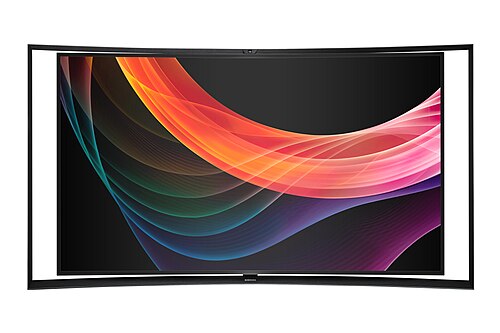
OLED panels use thin organic layers that glow when current flows, one emitter per sub-pixel. They offer perfect black, wide viewing angles, very fast response and thin, flexible designs. Their limits are lower full-screen brightness than the best LCDs and a risk of burn-in from static images.
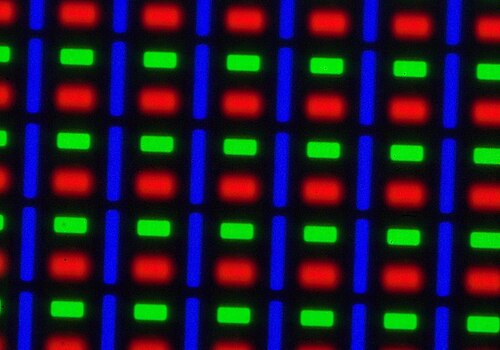

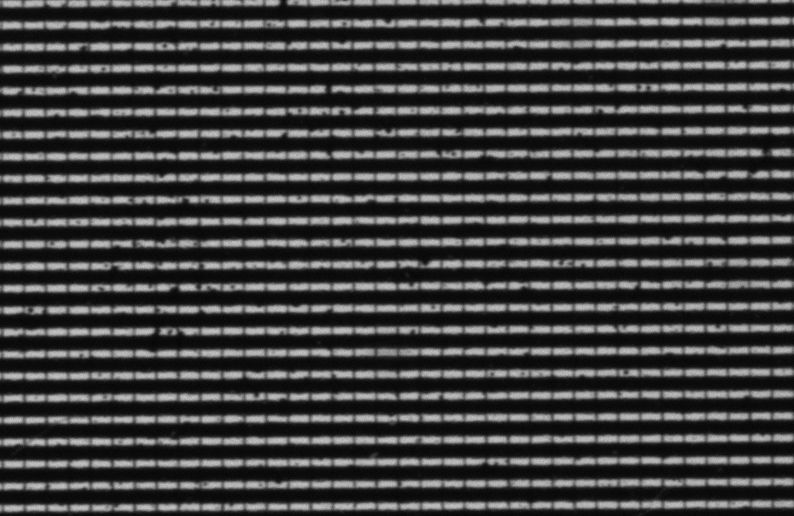
Phones and watches use AMOLED panels with red, green and blue organic emitters. Large TVs use WOLED (white OLED with color filters, LG Display) or QD-OLED (blue OLED with quantum-dot color conversion, Samsung Display, since 2022), and tablets, laptops and cars increasingly use tandem OLED, which stacks two emitting layers for more brightness and longer life. Recent OLED TVs reach roughly 1,000–2,000+ nits on small highlights, but automatic brightness limiting holds full-screen white to a few hundred nits. Burn-in, caused by uneven aging of the emitters, is now rare with mixed viewing but still possible with static logos and interfaces. More detail: OLED on the LED types page.


QLED (quantum-dot LCD)
A QLED TV is an LCD with a blue LED backlight and a film of quantum dots, nanocrystals that convert blue light into very pure red and green. That gives bright images and a wide color gamut at a lower price, but black levels depend on the backlight's local dimming.
The dots, about 2–10 nm across, emit a color set by their size: smaller dots glow green, larger ones red. Because their emission peaks are narrow, the LCD's color filters waste less light and reproduce 90% or more of the DCI-P3 cinema gamut. QLED panels have no burn-in risk and can run very bright, which suits sunny rooms. Without local dimming, though, blacks look grey in a dark room, and viewing angles on VA panels are narrower than on OLED. Many current QLED TVs pair quantum dots with a Mini-LED backlight.
Mini-LED
Mini-LED is an LCD backlight made of thousands of tiny LEDs grouped into hundreds or thousands of dimming zones. Each zone follows the picture, so blacks get deeper and highlights reach 1,000–3,000+ nits. The trade-off is blooming: faint halos around bright objects on dark backgrounds.
Mini-LED dies are typically 50–200 µm across. The 2021 12.9-inch iPad Pro, for example, used more than 10,000 of them in 2,596 zones, and premium TVs now exceed several thousand zones. More zones and smarter algorithms shrink blooming, but each zone still covers many pixels, so a single star on a black sky or white subtitles on a dark scene can show a soft glow that OLED and MicroLED avoid. In exchange, Mini-LED delivers the brightest HDR of any mainstream technology, with no burn-in, at a price well below MicroLED.
MicroLED
MicroLED builds every sub-pixel from a microscopic inorganic LED, combining OLED-style perfect blacks with very high brightness, efficiency and lifetime, and no burn-in. It is extremely expensive because millions of tiny dies must be grown, tested, transferred and repaired, so it is limited to luxury screens and modular walls.
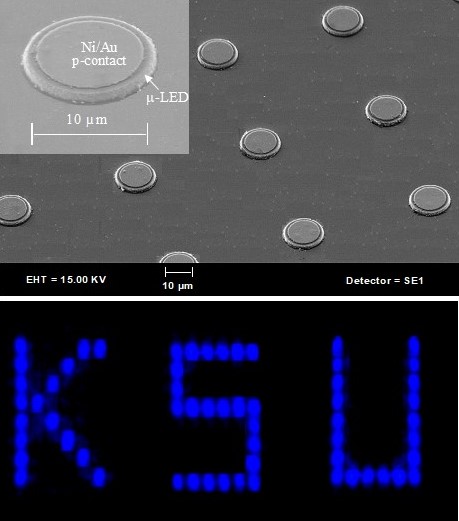

A 4K MicroLED screen needs about 24.9 million sub-pixel LEDs (3840 × 2160 × 3), each typically under 50 µm. Mass transfer must move them from the growth wafers to the display backplane by the million with near-perfect yield, and dead pixels must be found and repaired. Red micro-LEDs also lose efficiency as they shrink, because surface defects at the die edges matter more. Samsung's modular The Wall (2018) and its 110-inch MicroLED TV (2021), LG's MAGNIT and Sony's Crystal LED walls show what the technology can do, at prices in the tens of thousands of dollars and up. The history of the technology is told in The 2020s: the MicroLED era.
Side-by-side comparison
OLED and MicroLED win on black level and viewing angle; Mini-LED and MicroLED win on peak brightness; QLED wins on price. Only OLED carries a burn-in risk. For most buyers the real choice is OLED for dark rooms versus Mini-LED for bright rooms, with MicroLED still a luxury.
| Property | OLED | QLED | Mini-LED | MicroLED |
|---|---|---|---|---|
| Light source | Organic emitter per sub-pixel | Blue LED backlight + quantum dots + LCD | Thousands of tiny LEDs in dimming zones + LCD | Inorganic micro-LED per sub-pixel |
| Black level | Perfect | Grey without local dimming | Very deep; some blooming | Perfect |
| Peak HDR brightness | ~1,000–2,000+ nits (small areas) | ~500–1,500 nits | ~1,000–3,000+ nits | Several thousand nits |
| Viewing angle | Excellent | Fair (VA) to good (IPS) | Fair to good | Excellent |
| Burn-in | Possible with static content | None | None | None |
| Motion response | ~0.1 ms | Several ms | Several ms | Microseconds |
| Price | $$–$$$ | $–$$ | $$ | $$$$$ |
| Best for | Dark-room movies, gaming, phones | Bright rooms on a budget | Bright-room HDR, monitors, laptops | Luxury screens, modular walls, AR |
Which display technology should you choose?
Choose OLED for movies and gaming in dim rooms, Mini-LED for bright living rooms and HDR on a budget, and a basic QLED or LED-backlit LCD when price matters most. For screens showing static content all day, avoid OLED; MicroLED suits luxury installations and large modular walls.
- Dark-room cinema and gaming: OLED (WOLED or QD-OLED).
- Bright living rooms, sports and daytime HDR: Mini-LED, ideally with quantum dots.
- Lowest price: QLED or an LED-backlit LCD.
- Desktop work, dashboards and signage running all day: LCD or Mini-LED, to avoid burn-in.
- Phones and watches: AMOLED with an LTPO backplane is the norm.
- Lobbies, control rooms and luxury installations: MicroLED or fine-pitch direct-view LED walls.
What comes next
Next come tandem OLEDs in laptops and tablets, more efficient blue OLED emitters, quantum-dot LEDs driven directly by current, and cheaper MicroLED through better mass transfer. MicroLED microdisplays for augmented-reality glasses are the nearest mass market, while affordable MicroLED televisions remain a goal for the late 2020s and beyond.
Blue has always been OLED's weak point: it ages fastest and is least efficient. Phosphorescent blue emitters, long the missing piece, are moving from the lab toward production and could cut OLED power use noticeably. Electroluminescent quantum-dot displays (QD-EL or QDEL) would drop the organic emitter altogether. For MicroLED, larger wafers, faster mass transfer and monolithic microdisplays bonded directly to silicon drive costs down, starting with tiny, very bright panels for AR glasses, where no other technology is bright and efficient enough.
Frequently asked questions
Is QLED better than OLED?
OLED has perfect blacks, wider viewing angles and faster response. QLED is brighter at full screen, cheaper at large sizes and has no burn-in risk. In a dark room OLED usually looks better; in a very bright room QLED or Mini-LED may.
Is Mini-LED as good as OLED?
It comes close in many scenes and is brighter in HDR, but each dimming zone covers many pixels, so small bright details on black can show blooming. OLED controls every pixel individually.
Does OLED burn-in still happen?
It can, with static logos or interfaces shown for many hours every day. Pixel shifting, compensation cycles and better materials have made it rare with mixed viewing.
Why is MicroLED so expensive?
Every sub-pixel is a separate LED. A 4K screen needs about 25 million of them, and each must be grown, tested, transferred and, if faulty, repaired.
Is an "LED TV" an LED display?
Usually not in the self-emissive sense. Most "LED TVs" are LCDs with an LED backlight. Only MicroLED and direct-view LED video walls make the picture with LEDs directly.
Sources and further reading
- Y. Huang, E.-L. Hsiang, M.-Y. Deng, S.-T. Wu, "Mini-LED, Micro-LED and OLED displays: present status and future perspectives," Light: Science & Applications 9, 105 (2020).
- J. Y. Lin, H. X. Jiang, "Development of microLED," Applied Physics Letters 116, 100502 (2020).
- IEC 62341 series, Organic light emitting diode (OLED) displays, International Electrotechnical Commission (IEC).
- ITU-R BT.2100, Image parameter values for high dynamic range television; VESA DisplayHDR certification specification.
- U.S. DOE, "Solid-State Lighting R&D Opportunities" (2022), OLED and micro-LED technology status.
Image credits
- MicroLED display: Santasgift, CC BY-SA 4.0. Samsung OLED TV: Samsung Belgium, CC BY 2.0. AMOLED sub-pixels: Nick Spiker, CC BY-SA 3.0. Merck OLED display: Armin Kübelbeck, CC BY-SA 3.0. Aged OLED pixels: Badpeon, public domain. First MicroLED: Santasgift, CC BY-SA 4.0. All via Wikimedia Commons.