CRI and CCT: the color of LED light
How warm or cool a light looks, and how faithfully it shows colors
The color rendering index (CRI, Ra) is a score of up to 100 for how closely a light source reproduces the colors of standard test samples compared with a reference light of the same correlated color temperature (CCT). CCT, measured in kelvin, describes whether white light looks warm (2,700 K) or cool (6,500 K); CRI describes how faithfully it shows colors.
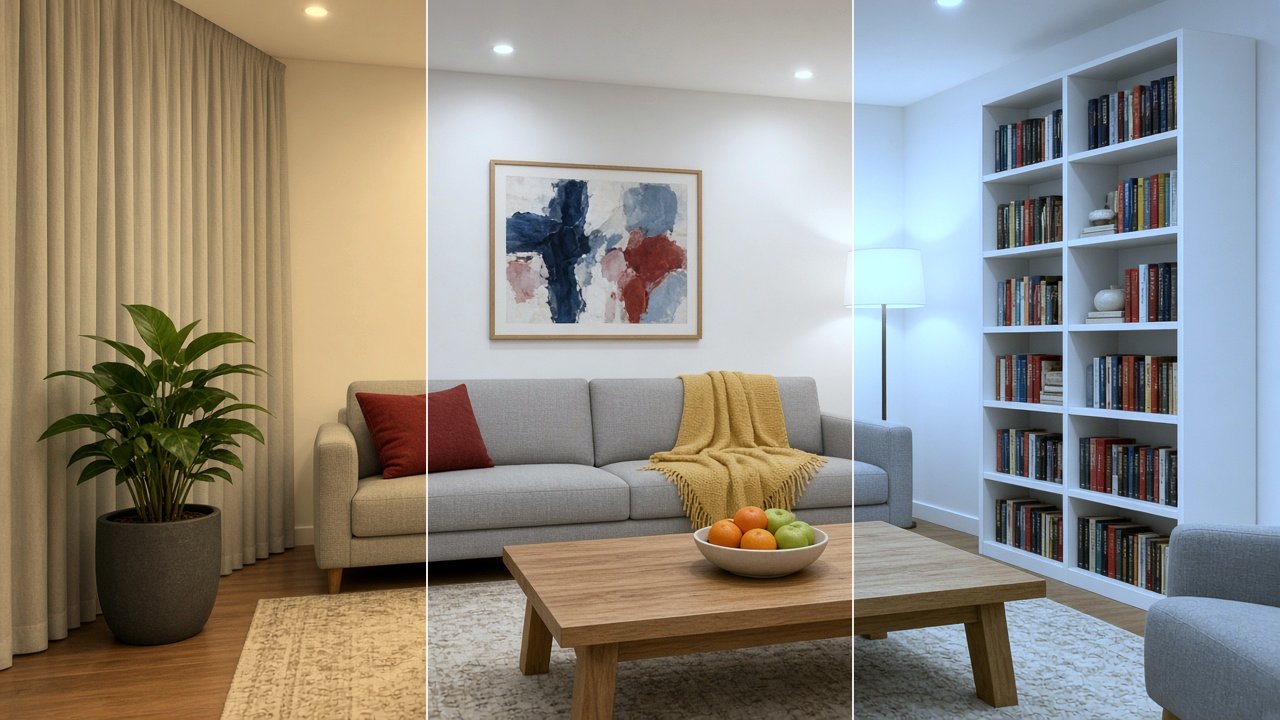
Two LED bulbs can have the same brightness and wattage yet make a room feel completely different. One looks cozy and makes food and skin glow; the other looks cold and flattens every color. The difference comes down to two independent properties: the light's color temperature and its color rendering. This guide explains both, the newer TM-30 metrics, and what to choose for each room.
Color temperature (CCT)
Correlated color temperature, in kelvin, describes whether white light looks warm or cool by comparing it with a glowing blackbody. Lower values look warmer: 2,700 K matches an incandescent bulb, 4,000 K is neutral white and 6,500 K resembles overcast daylight. CCT says nothing about color rendering.
A blackbody, an ideal glowing object, changes from red to orange, white and bluish white as it heats, tracing a curve on the chromaticity diagram called the Planckian locus. An LED's CCT is the temperature of the blackbody whose color it most resembles. Because an LED's color can also sit slightly above the curve (greenish) or below it (pinkish), a second number, Duv, gives that distance. ANSI C78.377 defines the standard nominal CCTs for LED products, from 2,200 K to 6,500 K, each with a tolerance zone. Dim-to-warm lamps glide from about 2,700 K down to 1,800–2,200 K as they dim, like a filament, and tunable-white fixtures let you choose any CCT, typically 2,700–6,500 K.
Interactive diagram: color temperature, LED spectra and color rendering
Spectral power distribution at this color temperature
| CCT | Appearance | Comparable to | Best for |
|---|---|---|---|
| 1,800–2,200 K | Very warm, amber | Candlelight, dimmed incandescent | Restaurants, bars, bedrooms at night, dark-sky outdoor lighting |
| 2,700 K | Warm white | Incandescent bulb | Living rooms, bedrooms, dining rooms |
| 3,000 K | Soft warm white | Halogen lamp | Kitchens, bathrooms, hotels, shops, streetlights |
| 3,500 K | Neutral warm | Some fluorescent tubes | Offices, classrooms, retail |
| 4,000 K | Neutral white | Cool-white fluorescent | Offices, garages, workshops, hospitals |
| 5,000 K | Daylight white | Direct midday sun | Color evaluation, art studios, warehouses |
| 6,500 K | Cool daylight | Overcast sky (D65) | Display calibration, some task lighting; can feel harsh at home |
| 10,000 K | Bluish | Clear blue sky | Marine aquariums, special effects |
Color rendering index (CRI, Ra)
The color rendering index, Ra, is a score of up to 100 for how closely eight pastel test colors look under a lamp compared with a reference source of the same CCT. Ra 80 is the usual indoor minimum, Ra 90 or more is recommended for homes and shops, and 95+ for color-critical work.
The method, defined in CIE 13.3-1995, measures the color shift of each test sample. The general index Ra is the average of the first eight pastel samples, R1–R8. Six more "special" indices, R9–R14, cover saturated red, yellow, green and blue, a light skin tone and leaf green, and many datasheets add R15, an Asian skin tone. Because Ra is an average of pastels only, a lamp can score Ra 80 while rendering saturated reds badly.
Requirements vary: the European workplace standard EN 12464-1 sets Ra 80 for most indoor work, ENERGY STAR lamps need Ra 80 with R9 above zero, and California's JA8 high-efficacy rules require Ra 90 and R9 of at least 50. Higher CRI costs some efficiency: a 90-CRI LED typically makes 10–20% fewer lumens per watt than an otherwise similar 80-CRI LED, because part of its output is shifted into deep red, where the eye is less sensitive.
R9: why deep red matters
R9 is the CRI score for a saturated red sample, and it is not included in the Ra average. Many cheap white LEDs score near zero or below, making skin, food and wood look dull. Look for R9 of 50 or more for homes and 90 or more for color-critical work.
Standard white LEDs make light with a blue chip and a yellow YAG phosphor, which emits little beyond about 650 nm. High-CRI LEDs add a nitride red phosphor that fills in the deep red, so meat and tomatoes look fresh, wood looks rich and skin looks healthy rather than sallow. The interactive diagram above shows the difference: the low-CRI spectrum falls away in the red, while the high-CRI spectrum stays high. Retail, hospitality, healthcare and photography lighting often specify R9 of 80–90 or more.
TM-30: fidelity (Rf) and gamut (Rg)
TM-30 replaces CRI's eight pastels with 99 color samples and reports two main numbers: Rf, a fidelity score from 0 to 100, and Rg, a gamut score where 100 matches the reference, above 100 is more saturated and below is duller. A color-vector graphic shows which hues shift.
ANSI/IES TM-30, first published in 2015 and revised in 2018 and 2020, uses a modern color space and real-world samples such as skin, foods, fabrics and paints. Its fidelity index matches the CIE's own Rf (CIE 224:2017). Two lamps with the same Rf can render colors very differently: one may desaturate reds while another boosts them, which the color vector graphic and the red chroma shift (Rcs,h1) make visible. Research summarized in TM-30 found that people usually prefer light that slightly increases red saturation, with Rg a little above 100. A practical specification is Rf of 90 or more where accuracy matters, as in museums and print rooms, and Rf in the mid-80s or higher with Rg of about 100–110 where people simply want colors to look good.
Recommended CCT and CRI by room
Use warm 2,700–3,000 K light with CRI 90+ in living rooms and bedrooms, 3,000–4,000 K with CRI 90+ in kitchens and bathrooms, and 3,500–4,000 K in offices. Shops and galleries benefit from CRI 95+ with high R9, and outdoor lighting should stay at 3,000 K or below.
| Space | CCT | CRI (Ra) | R9 | Notes |
|---|---|---|---|---|
| Living room | 2,700–3,000 K | 90+ | 50+ | Dim-to-warm for evenings |
| Bedroom | 2,200–2,700 K | 90+ | 50+ | Warm and dimmable; avoid bright cool light at night |
| Kitchen | 3,000–4,000 K | 90+ | 50+ | Food and skin look natural; bright task light on counters |
| Bathroom vanity | 3,000–4,000 K | 90–95+ | 50+ | Even, front-facing light for grooming and makeup |
| Home office | 3,500–4,000 K | 90+ | — | Alert, neutral light by day |
| Office, classroom | 3,500–4,000 K | 80–90 | — | EN 12464-1 minimum is Ra 80 |
| Retail: fashion, food | 3,000–3,500 K | 90–98 | 80+ | Reds and skin tones sell products |
| Museum, gallery | 2,700–3,500 K | 95–98 | 90+ | Rf 90+, minimal UV |
| Garage, workshop | 4,000–5,000 K | 80–90 | — | Higher light levels for detail work |
| Healthcare examination | 3,500–5,000 K | 90+ | 50+ | Accurate skin color for diagnosis |
| Outdoor, streets | 3,000 K or less | 70+ | — | Shielded fixtures; 2,200–2,700 K near habitats |
Color consistency: MacAdam steps and Duv
Two LEDs with the same nominal CCT can still look different. MacAdam ellipse steps measure that difference: within 1–2 steps it is invisible, 3 steps is barely noticeable, and 5 or more is obvious side by side. Specify 3-step or tighter for rows of downlights and long linear runs.
Manufacturers sort LEDs into color bins after production; tighter bins cost more. An ANSI C78.377 nominal-CCT quadrangle is roughly the size of a 7-step ellipse, which is why two "3000 K" products from different brands can visibly clash. The full step-by-step table is in How LEDs work: binning. Duv also matters: ANSI allows about ±0.006 around the target, and experiments by Ohno and Fein at NIST found that many people prefer white light slightly below the blackbody curve (negative Duv), which looks crisp rather than greenish.
How to read a lighting label
Check four things on the box: lumens for brightness, CCT in kelvin for warmth, CRI (and R9 if listed) for color quality, and whether the lamp is dimmable. Three-digit codes are common shorthand: 927 means CRI 90+ at 2,700 K, and 840 means CRI 80+ at 4,000 K.
In the United States, the FTC Lighting Facts label shows brightness in lumens, estimated yearly energy cost, life in years, light appearance on a warm-to-cool scale and the watts used. In the European Union, the energy label was rescaled in September 2021: class A now requires at least 210 lumens per watt, so even good LED lamps often show D or E, and the product database lists CRI and other data. Professional catalogues use the three-digit code everywhere: the first digit is the CRI band (8 = 80+, 9 = 90+) and the last two are the CCT in hundreds of kelvin, so 830, 927 and 965 are 80+ at 3,000 K, 90+ at 2,700 K and 90+ at 6,500 K.
Frequently asked questions
Is 2700K or 3000K better?
2,700 K matches incandescent warmth and suits living rooms and bedrooms; 3,000 K is slightly crisper and suits kitchens and bathrooms. Either works if you use the same CCT throughout a room.
What CRI do I need?
Ra 90 or more with R9 of at least 50 for homes; Ra 80 is the usual minimum for offices; Ra 95+ for museums, retail and photography.
What is a good R9 value?
50 or more is good and 90 or more is excellent. Many 80-CRI LEDs score R9 near zero, which makes reds look dull.
Is 5000K good for a home?
It works in garages and workshops, but most people find it cold and clinical in living spaces, especially in the evening. 2,700–3,000 K is more relaxing.
Does higher CRI use more energy?
Slightly. High-CRI LEDs make roughly 10–20% fewer lumens per watt, because some light is shifted into deep red, where the eye is less sensitive.
What is Duv?
The distance of a light's color from the blackbody curve. Positive values look greenish and negative values pinkish; ANSI allows about ±0.006, and many people prefer a slightly negative Duv.
Sources and further reading
- CIE 13.3-1995, Method of Measuring and Specifying Colour Rendering Properties of Light Sources, International Commission on Illumination (CIE).
- ANSI/IES TM-30-20, IES Method for Evaluating Light Source Color Rendition; CIE 224:2017, Colour Fidelity Index for accurate scientific use.
- ANSI C78.377-2017, Specifications for the Chromaticity of Solid-State Lighting Products.
- EN 12464-1:2021, Light and lighting: Lighting of work places, Part 1: Indoor work places.
- California Energy Commission, Building Energy Efficiency Standards, Joint Appendix JA8, High-Efficacy Light Sources.
- Y. Ohno, M. Fein, "Vision experiment on acceptable and preferred white light chromaticity for lighting," CIE x039:2014 conference proceedings.
- U.S. DOE Solid-State Lighting Program, "Evaluating Color Rendition Using IES TM-30" fact sheet.
Image credits
- 800-lumen LED bulb: ArnoldReinhold, CC BY 4.0, via Wikimedia Commons. Diagram: LEDlights.org.
- Living room at 2,700 K, 4,000 K and 6,500 K: AI-generated illustration by LEDlights.org.