3157 vs 7443 bulbs
The wedge-base bulbs in brake, tail, turn-signal and reversing lights
3157 and 7443 are dual-filament wedge bulbs used in brake, tail, turn-signal and parking lights. The 3157, or P27/7W, is a 27/7 W bulb on a W2.5×16q base; the 7443, or W21/5W, is a 21/5 W bulb on a W3×16q base. The wedges differ, so the two do not interchange.
Wedge bulbs need no metal base: the contacts are wires folded around a wedge of glass or plastic, which makes them cheap and compact. The 3157 and the 7443 are the dual-filament workhorses of the type, and because they look so alike in a parts catalog, buying the wrong one is easy. So is fitting an LED version to a socket wired the other way.
What is the difference between 3157 and 7443?
Both are dual-filament wedge bulbs for brake and tail or turn and parking lights, but they are different sizes. A 3157 is a 27/7 W bulb on a W2.5×16q base; a 7443 is a 21/5 W bulb on a W3×16q base. The bases differ in shape and size, so each socket takes only its own type.
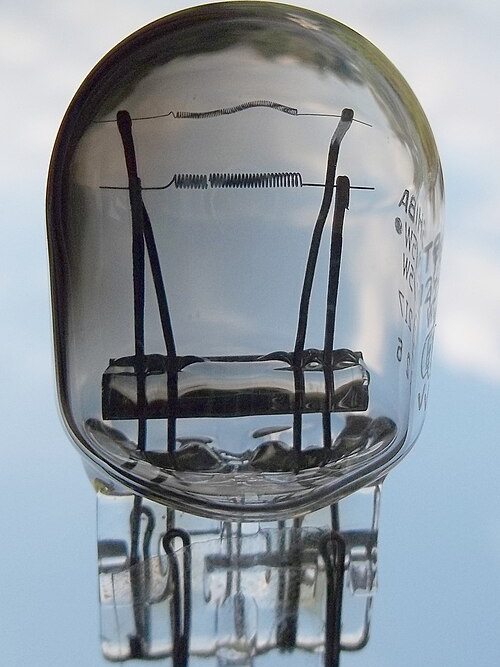

In the base codes, W means wedge, the first number is the wedge's thickness and the second its width, both in millimeters, and the last letter counts the contacts: d for two, q for four. T25 and T20 are aftermarket names for roughly the glass diameter in millimeters.
| Bulb | European name | Base | Filaments | Power | Typical use |
|---|---|---|---|---|---|
| 3156 | P27W | W2.5×16d | 1 | 27 W | Reversing lights, turn signals |
| 3157 | P27/7W | W2.5×16q | 2 | 27/7 W | Brake and tail, parking and turn |
| 7440 | W21W | W3×16d | 1 | 21 W | Reversing lights, turn signals |
| 7443 | W21/5W | W3×16q | 2 | 21/5 W | Brake and tail, parking and turn |
Which bulbs fit which socket?
Each family has a single- and a dual-filament version: 3156 and 3157, 7440 and 7443. A dual-filament bulb works in its single-filament sibling's socket, using the bright filament, but a single-filament bulb in a dual socket leaves the second function dark. A 3157 never fits a 7443 socket, nor the reverse.
That makes the dual-filament bulb the safe spare: a 7443 can stand in for a 7440 in a reversing light. The reverse is a common mistake, because a 7440 in a brake-and-tail socket lights only when braking, leaving the car without tail lights at night.
Standard and CK sockets
Some vehicles wire their 3157 or 7443 sockets in the CK pattern, also sold as SRCK, with the two ground contacts side by side instead of on opposite sides of the base. Filament bulbs work either way, but LEDs are polarized, so a standard LED bulb in a CK socket may not light or may blow the fuse.
CK sockets turn up in a minority of vehicles, often in the front turn signals, across several makes, including some Toyota, Honda, Nissan, Ford and General Motors models. Bulb makers' vehicle lists show which you have, or a multimeter can find the two ground contacts in the socket. LED bulbs marked CK or SRCK are made for these sockets, and some LED bulbs work in both.
Choosing LED 3157 and 7443 bulbs
Match the base and filament count, then check three things: red or amber bulbs behind clear lenses must emit that color, monitored circuits may need CANbus-ready bulbs or load resistors, and the LED bulb must fit inside the housing. LED brake lights reach full brightness a fraction of a second sooner than filament bulbs.
That head start gives the driver behind slightly more warning. The step between tail and brake brightness matters as much as it does with 1157 bulbs, so check from behind the car that braking makes a clear difference. LED turn signals usually need a fix for hyperflash; see CANbus LED bulbs and hyperflash. Neither the 3157 nor the 7443 has an approved LED substitute under UN rules.
Frequently asked questions
Is a 7443 the same as a 7440?
No. A 7440 has one filament and a 7443 two. A 7443 can replace a 7440, using its bright filament, but a 7440 cannot do the tail-light job of a 7443.
Will a 3157 fit a 7443 socket?
No. The wedges differ in size and shape, so neither bulb fits the other's socket.
Do LED 3157 bulbs need resistors?
On turn signals, usually yes, and on brake lights if the car monitors them. CANbus-ready bulbs avoid most resistors; see the hyperflash guide.
How do I know if my socket is CK?
Check the bulb maker's vehicle list, or find the two ground contacts with a multimeter: side by side means CK, on opposite sides means standard.
Sources and further reading
- IEC 60061-1, Lamp caps and holders together with gauges for the control of interchangeability and safety: Lamp caps (W2.5×16d, W2.5×16q, W3×16d and W3×16q caps).
- UN Regulation No. 37, uniform provisions for filament light sources in approved vehicle lamps, with category sheets in the Consolidated Resolution R.E.5 (P27W, P27/7W, W21W and W21/5W).
- FMVSS No. 108, 49 CFR 571.108: color and intensity requirements for stop, tail and turn-signal lamps.
Image credits
- 3157 bulb: MattiPaavola, CC BY-SA 3.0. W21/5W bulb: Hundehalter, CC BY-SA 3.0, cropped. Both via Wikimedia Commons.