Landscape lighting transformer sizing
12 V loads, cable gauge, voltage drop and the rules for installing them
A landscape lighting transformer converts mains power to about 12 V AC for outdoor low-voltage lights. It isolates the garden wiring from the mains, which is why the cable may be buried shallowly, and its rating in volt-amperes (VA) sets how many fixtures it can supply.
A 12 V system is the most forgiving way to light a garden: the cable can be buried shallowly and moved as plants grow, and at 15 V or less the code allows it even where wet contact is likely. Two numbers decide whether it works: the transformer's rating, and the voltage left at the far end of each cable. This guide works through both.
How to size a landscape transformer
Add the VA of every fixture and divide by 0.8, because a transformer should carry no more than 80% of its rating. Twelve path lights at 4.5 VA and four spotlights at 7 VA total 82 VA, so they need at least 103 VA: a 150 VA transformer. Use VA, not watts, because LED drivers draw more VA than watts.
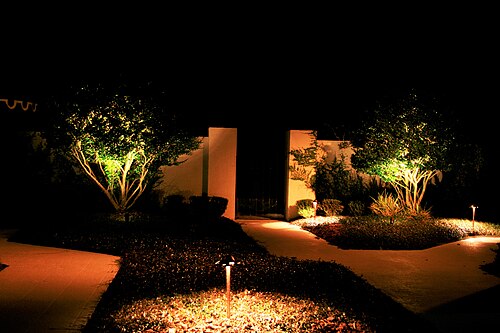

Volt-amperes are volts times amperes. For a lamp filament they equal watts, but an LED driver draws its current in short peaks, out of step with the voltage, so its power factor is below 1 and it needs more VA than watts: FX Luminaire's one-LED path light, for example, uses 2.0 W but 2.4 VA, and its spec sheets say to size transformers by the VA figure. The 80% margin, from the AOLP's landscape lighting guidelines, leaves room for fixtures added later and keeps the transformer from running at its limit.
Each 12 V circuit is limited to 25 A, which is 300 W at 12 V, so larger transformers split their output into several circuits of up to 300 W each. Connect each cable run to its own terminals, and keep each run within both the circuit's limit and its cable's limit, below.
Choosing the cable gauge
Thicker cable carries more load and loses less voltage. AOLP's guidelines allow about 125 W on 16 AWG, 144 W on 14 AWG, 192 W on 12 AWG and 288 W on 10 AWG at 80% of rating. Landscape cable is sold as two-conductor 16/2, 14/2, 12/2 and 10/2.
| Gauge | Rating | At 12 V | At 80% |
|---|---|---|---|
| 18 AWG | 10 A | 120 W | 96 W |
| 16 AWG | 13 A | 156 W | 125 W |
| 14 AWG | 15 A | 180 W | 144 W |
| 12 AWG | 20 A | 240 W | 192 W |
| 10 AWG | 30 A | 360 W | 288 W |
| 8 AWG | 40 A | 480 W | 384 W |
These limits keep the cable from overheating. On a long run, voltage drop usually sets the limit first.
Voltage drop on 12 V runs
At 12 V, cable resistance matters: 100 W at the end of 100 feet of 12 AWG cable loses about 2.6 V, leaving 9.4 V. LED fixtures that accept 9 or 10 V may cope, but halogen lamps need 10.8 V or more. Use thicker cable, shorter runs, a T or hub layout, or a higher transformer tap.
| Gauge | 50 W | 100 W | 150 W | 200 W | 300 W |
|---|---|---|---|---|---|
| 16 AWG | 59 | 29 | — | — | — |
| 14 AWG | 95 | 47 | — | — | — |
| 12 AWG | 151 | 75 | 50 | — | — |
| 10 AWG | 240 | 120 | 80 | 60 | — |
| 8 AWG | 383 | 191 | 127 | 95 | 63 |
A dash means the load exceeds the cable's 80% rating in the AOLP table above. The table counts both conductors: the loop resistance is twice the run length times copper's resistivity, 0.0172 Ω·mm²/m, divided by the conductor's cross-section (3.31 mm² for 12 AWG). For halogen lamps, which need 10.8 V, the drop must stay under 1.2 V, so multiply the runs by 0.6. LED drivers draw a little more current as the voltage falls, which makes the drop slightly worse than this simple model.
If the fixtures are spread evenly along the run instead of bunched at the end, the voltage at the last one falls by about half as much, so the run can be about twice as long; the "wire constant" rules of thumb in landscape catalogs assume something close to that. The wire-gauge section of the LED strip calculator uses the same arithmetic. The surest check is a meter at the far fixture with the system on.
Multi-tap transformers
A multi-tap transformer offers several output voltages, such as 12, 13, 14 and 15 V, so a long run can start higher and still arrive in range. Choose the tap that puts the last fixture inside its rated range without pushing the nearest one past its maximum. Landscape-listed transformers stop at 15 V.
Units with taps above 15 V, up to 30 V, are general-purpose transformers listed under UL 506 rather than UL 1838, according to the AOLP, and where wet contact is likely the NEC limits these lighting circuits to 15 V AC. LED fixtures are tolerant: Vista's PR-4201 accepts 9–15 V and FX Luminaire's fixtures 10–15 V, so a 12 V tap usually suffices except on long or heavily loaded runs. Halogen systems were far fussier, needing 10.8 to 12 V at every lamp.
Wiring layouts: daisy chain, T, hub and loop
A daisy chain runs one cable past every fixture, so the last ones get the lowest voltage. A T layout feeds the middle of the group, splitting the drop. A hub layout runs one cable to a central point and equal leads out to each fixture. A loop brings both ends back to the transformer, evening out voltage.
Four ways to wire a 12 V run
The hub layout gives every fixture nearly the same voltage, because each lead carries only its own fixture's current over the same distance; it suits groups of path lights. The T and loop methods suit long rows. Splices should use connectors made for direct burial.
Installation rules
Plug the transformer into a GFCI-protected outdoor receptacle with a weatherproof in-use cover, and mount it at least 12 inches above the ground. Keep it at least 10 feet from pools, spas and fountains unless it is listed for that use. Bury the 12 V cable at least 6 inches, deeper under driveways.
The NEC's Table 300.5 allows 6 inches of cover for landscape lighting circuits of 30 V or less in UF or other identified cable, but 18 inches under the driveway of a one- or two-family home and 24 inches under streets and parking lots; cover is measured to the top of the cable. Article 411 requires a listed system or listed parts, and an isolating transformer rather than an autotransformer, so the 12 V side has no direct connection to the mains, and IAEI notes that the transformer is supplied from a branch circuit of no more than 20 A. Local codes can be stricter.
Frequently asked questions
What size transformer do I need for 10 LED landscape lights?
Add their VA ratings and divide by 0.8. Ten path lights at 4.5 VA total 45 VA and need at least 57 VA, so even a small transformer will do. Check each fixture's spec sheet for its VA.
Can a landscape transformer be too big?
Not in itself: the rating is a ceiling, and an LED load far below it is fine. Each 12 V circuit is still limited to 25 A, and each cable must be sized for the load on it.
Can I mix LED and halogen fixtures on one transformer?
Yes, if the total VA fits, but the halogen lamps need 10.8–12 V at the lamp while LEDs accept a wider range. Set the tap for the halogens, and expect the farthest ones to look dimmer and warmer.
How deep do I bury low-voltage landscape wire?
At least 6 inches of cover to the top of the cable under the NEC, 18 inches under a home's driveway and 24 inches under streets and parking lots. Local codes can be stricter.
Why are the lights at the end of my run dim?
Voltage drop: the cable's resistance takes a share of the 12 V before it reaches them. Use thicker cable, split the run with a T or hub layout, or move to a higher tap, and check with a meter.
What does 12/2 mean on landscape wire?
Two conductors of 12 AWG copper. 10/2 is thicker and carries more; 16/2 is thinner and suits only short, light runs.
Sources and further reading
- Association of Outdoor Lighting Professionals (AOLP), Landscape Lighting Guidelines (2021): transformer loading, cable ratings, transformer listings and halogen lamp voltage.
- UL 1838, Low Voltage Landscape Lighting Systems; UL 506, Specialty Transformers.
- NFPA 70, National Electrical Code (2023): Article 411, Table 300.5, and the GFCI and wet-location receptacle requirements.
- IAEI Magazine (2004): Article 411 low-voltage lighting systems.
- "Low-voltage decorative yard lighting", Electrical Contractor magazine.
- FX Luminaire path-light specification sheets (watts and VA); Vista Professional Outdoor Lighting PR-4201 specification.
- Voltage drop: calculated by LEDlights.org with copper resistivity 0.0172 Ω·mm²/m and standard AWG conductor areas.
Image credits
- Path lights and lit garden: Asaph441, CC BY-SA 4.0, via Wikimedia Commons. Layout diagram: LEDlights.org.